

THE shortly-to-be-confirmed Dean of St Christopher’s Cathedral has had to walk a diplomatic tightrope after finding his first days in Bahrain clashing with a global Anglican church constitutional rainbow crisis.
It appears there will be no culturally offensive and illegal same-sex couples having their relationships blessed in Manama in the immediate future despite the General Synod – the Church of England’s legislative assembly – having passed a motion to allow it.
The row over the Church of England’s decision erupted again last week after news broke that the Archbishop of Canterbury Justin Welby had been ousted as their head by some overseas clergy, as reported in the GDN.
“The issue of communion is a much larger thing than just one particular issue,” said the Rev Richard Fermer.
“So if you’re committed to communion you need to be thinking not only about it but also about the whole,” he explained. “And also, when you come with empty hands to a country which is not your own, you have to think about the whole as well here.
“I want to be able to interact with Bahraini society and the Islamic faith here in this country, and so I want to be able to not have the door shut.
“In response to the controversial question, I am not giving my individual response because I don’t work as a lone individual, but like the Archbishop I have responsibilities to hold together communities that have different points of view.
“Archbishop Welby has the unenviable calling of holding together the ninety-million strong, global Anglican communion of churches, recognising that churches in some countries wish to respond to changes within their societies, not because social change should determine belief, but rather because God’s love needs to be expressed in a way which speaks into that context.
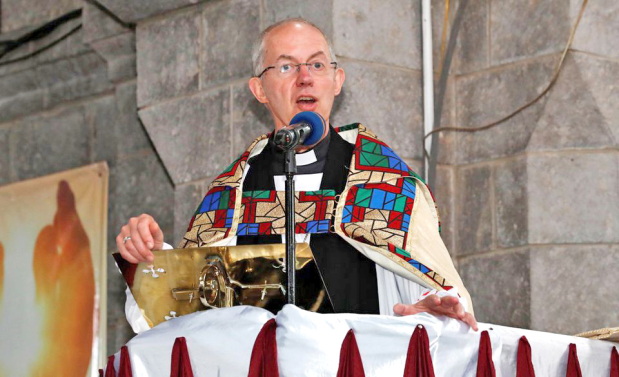
Archbishop Welby
“Other churches, within the same communion, have different interpretations of scripture and are opposed to responding to such social changes which are not necessarily part of their context.
“Here at St Christopher’s in Bahrain, we have Christians from many nations and church backgrounds, so we need to be sensitive to all sides of any issue.
“Anglicans have traditionally said we can live in communion with each other because we agree on the essentials of faith, while allowing space to have differences about other issues.
“Everything is larger than one particular issue so, if you want my view, I can give you my view … but when was faith just solely about my view?
“This is the problem. The invidious position that the Archbishop Welby of Canterbury is in. On one hand, he cannot just dismiss the issue of the evolving nature of society in many parts of the world. Also, the reality is that the church’s position causes people pain and suffering. That is the reality and people have been ignored, have been persecuted and that needs to be recognised.
“On the other hand, there are people who can’t accept this, at this point in time. It’s not as definitive as many have made it out to be in the past because the gospel is a gospel of love, and God is a God of love, we need to be able to recognise authentic love wherever it occurs. There are people, including in the UK and in North America, who do not agree with that.
“Then there are people in other parts of the world where actually, culturally, this subject is taboo. It’s very difficult to talk about these things.
“My opinion is to go back to the phrase of peaceful co-existence. As the Anglican Communion, we have to be able to recognise that there is going to be utterance and difference in our communion as well as what we share.”
But now the Global South Fellowship of Anglican Churches (GSFA) said in a statement it no longer considers Archbishop Welby to be ‘leader of the global communion’, and it has ‘disqualified’ the Church of England from being its ‘mother church’.
The move by the group of 12 Anglican Archbishops to remove the senior cleric goes against more than 150 years of tradition that has seen the Archbishop of Canterbury considered the spiritual leader of the Anglican Communion since its formation in 1867.
The GSFA said it speaks for 75 per cent of Anglicans around the world, officially representing 25 member provinces – mainly in Asia, Latin America and Africa. In its statement released on Monday, the group accused the Church of England of ‘taking the path of false teaching’ and going against ‘the historical biblical faith’ by allowing same-sex blessings, adding: “This breaks our hearts.”
Critics suggest the church is trying to have the ‘best of both worlds’ and, although refusing to stage same-sex weddings, had wilted under Western political pressure to dismiss its own teachings by conducting blessings.
&uuid=(email))