

A 14-YEAR-OLD girl tragically died from a cardiac arrest at a hospital in the early hours of yesterday after complaining of chest pains the previous afternoon.
Asian School Grade 9 student Sera Raichel Aji Varghese, who hails from Pattanamthitta district in Kerala, was taken to hospital around 1am by ambulance, after she began vomiting and suddenly lost consciousness.
A family member revealed that they were told by the hospital she had suffered a heart attack arising from diabetes-related complications, although she had appeared to have been in perfect health for the last year.
The Asian School Bahrain issued condolences on its website, noting that Sera passed away after a ‘cardiac arrest due to diabetic ketoacidosis’.
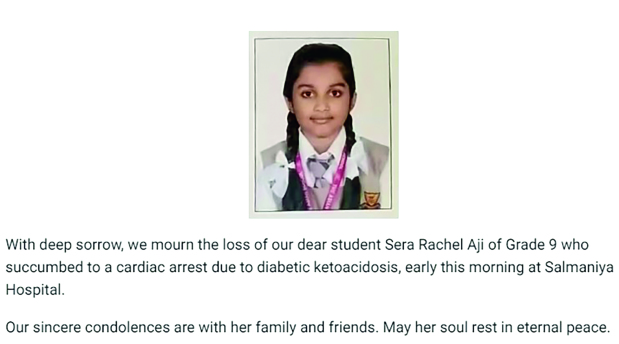
The Asian School Bahrain’s condolences message posted on their website
The popular teenager leaves behind her parents Aji K Varghese and Manju Varghese, and an elder sister, Shraddha Mariam Aji Varghese, who is currently studying abroad.
“Sera was a quiet but bright student who had been doing well academically,” Asian School principal Molly Treasa Mammen told the GDN.
“Her parents told us that she felt pain in her stomach and legs before she began vomiting and fainted.”
The US Centre for Disease Control and Prevention describes diabetic ketoacidosis as a serious complication of diabetes that can be life-threatening and is most common among people with Type 1 diabetes, mostly a childhood disease that continues to baffle scientists and medics with some suggesting different factors, such as genetics and some viruses.
Latest research suggests Type 1 diabetes could be caused by an autoimmune reaction, when the body attacks itself by mistake. This reaction destroys the cells in the pancreas that make insulin, called beta cells. This process could go on for months or years before any symptoms appear.
According to Royal Bahrain Hospital Medical Centre Janabiya paediatric consultant Dr Mona Issa, symptoms of Type 1 diabetes include feeling very thirsty, urinating more frequently than usual especially at night, fatigue, weight-loss and loss of muscle bulk, itchiness around the genital area or regular bouts of thrush – a yeast infection, as well as blurred vision caused by the lens within the eye changing shape.
“A random blood sugar test is the primary screening method for Type 1 diabetes,” she added.
“Insulin dependent diabetes mellitus (IDDM), also known as Type 1 diabetes, usually starts before 15 years of age.
“It’s a lifelong condition that can lead to serious complications, especially if it’s not managed well. With careful monitoring and proper use of insulin, you can set your child on the path to a long, healthy life.
“Patients with Type 1 diabetes mellitus (DM) require lifelong insulin therapy. Most require two or more injections of insulin daily, with doses adjusted on the basis of self-monitoring of blood glucose levels.”
According to the British charity Diabetes UK, although Type 1 diabetes usually appears during childhood, it can be sometimes diagnosed later in life too. Even after substantial research, Type 1 diabetes has no cure.
Treatment is directed towards managing the amount of sugar in the blood using insulin, diet and lifestyle to prevent complications.
Sera’s body will be flown back to Kerala in the coming days for her last rites.
naman@gdnmedia.bh
&uuid=(email))