

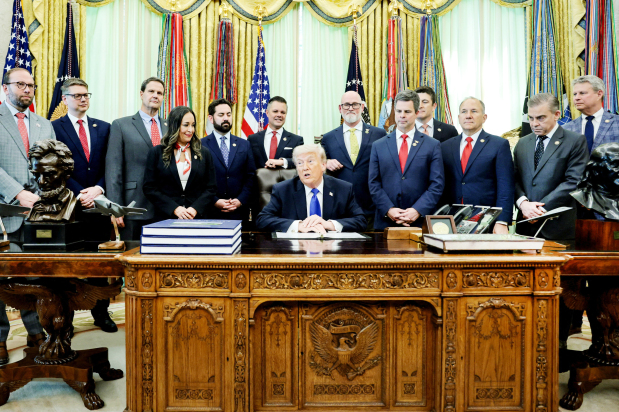
US President Donald Trump faces a deadline today to end the Iran war or make the case to Congress for extending it, but the date is most likely to pass without altering the course of a conflict that has lapsed into a standoff over shipping routes.
Ending the war appears highly unlikely.
Instead, analysts and congressional aides said they expect Trump to notify Congress that he plans a 30-day extension or disregard the deadline, with his administration arguing that a current ceasefire with Tehran marked an end to the conflict.
Like most policies in a bitterly divided Congress, war powers have become deeply partisan, with opposition Democrats calling for Congress to reassert its constitutional right to declare war and Republicans accusing Democrats of trying to use War Powers law to weaken Trump.
Democrats have tried repeatedly since the war began on February 28 to pass resolutions to force Trump to withdraw US forces or obtain congressional authorisation.
But Trump’s Republicans, who hold slim majorities in the Senate and House of Representatives, have voted them down almost unanimously.
Republicans blocked a sixth such effort in the Senate yesterday, a day before the war powers deadline, although Senator Susan Collins of Maine, who has voted against previous resolutions, became the second member of her party to back the measure, along with Senator Rand Paul of Kentucky, who has backed all of the resolutions.
Under the 1973 War Powers Resolution, the president can wage military action for only 60 days before ending it, coming to Congress for authorisation or seeking a 30-day extension due to “unavoidable military necessity regarding the safety of United States Armed Forces.”
The Iran conflict began on February 28, when Israel and the United States began air strikes on Iran.
Trump formally notified Congress of the conflict 48 hours later, starting the 60-day deadline clock that ends today.
Trump was scheduled to receive a briefing yesterday on plans for fresh military strikes on Iran to compel it to negotiate an end to the conflict, a US official told Reuters.
If fighting resumes, Trump can tell legislators he has started another 60-day clock, something presidents from both parties have done repeatedly since Congress passed the War Powers law, over then-President Richard Nixon’s veto, in response to the Vietnam War.
That conflict also was not authorised by Congress.
The administration may also argue that today is not the deadline, because of a ceasefire that Trump announced on April 7.
Secretary of Defence Pete Hegseth told a Senate hearing yesterday that his understanding was that the 60-day clock stopped during a ceasefire.
Democrats disputed that, saying there was no such provision in the war powers law.
Iran said yesterday that if Washington renewed attacks it would respond with “long and painful strikes” on US positions, complicating Washington’s hopes for an international coalition to open the Strait of Hormuz.
Polls show the Iran war is unpopular among Americans, six months before November elections that will determine who controls Congress next year.
Trump’s approval rating sank to the lowest level of his current term this month, as Americans soured on the cost of living and blamed the war for higher prices.
But Trump remains strongly in control of his party and few Republicans have objected to his policies.
Additionally, Republicans strongly back Israel, which is also striking Iran, and welcome weakening of Iran, a bitter enemy of the United States.
“It’s partisanship, plain and simple,” said Christopher Preble, a senior fellow at the Stimson Centre think tank in Washington.
“Republicans refuse to defy the president, simple as that.”
The White House has not said how it plans to proceed, or if it will ask Congress to authorise the Iran campaign.
“The administration is in active conversations with the Hill on this topic. Members of Congress who try to score political points by usurping the Commander-in-Chief’s authority would only undermine the United States Military abroad, which no elected official should want to do,” a White House official said on condition of anonymity.

&uuid=(email))