

THE protection zone around Bahrain’s first world heritage site has been redefined to allow for more urban development projects in the area.
The Capital Trustees Board has approved an urgent request by the Housing and Urban Planning Ministry to reduce the protected area without harming the view of Bahrain Fort which was declared a Unesco World Heritage Site in 2005.
The freed-up area will be used for new government homes, buildings and facilities for social services.
According to urban planner Marwa Hattab, who was present at the board’s meeting held at the Municipalities Affairs and Urban Planning Ministry, the go-ahead has been given following consultations with the Bahrain Authority for Culture and Antiquities (Baca).
“The existing boundary was drawn up years ago to provide extra protection to the area, but a recent review has shown that the boundaries extend beyond what was originally required,” said Ms Hattab.
“International requirements for the area continue to be protected, and the view remains unharmed under Unesco rules,” she added.
“The plots that will be now freed will be used for either housing projects, buildings and facilities for social services.”
Meanwhile, board chairman Saleh Tarradah said Bahrain has limited space for urban development.
“We are not saying that historical or archaeological sites should be razed to pave way for development,” he said.
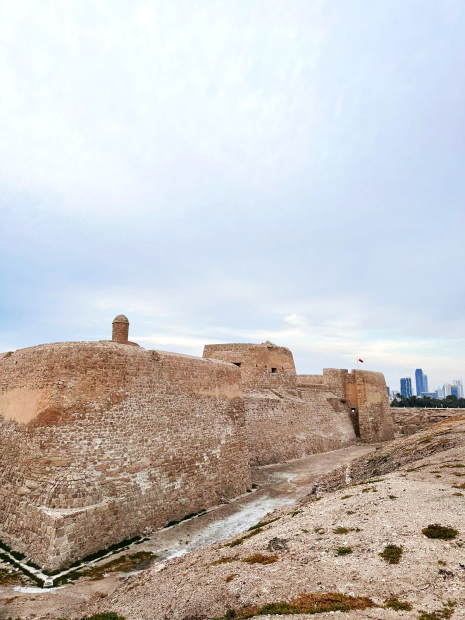
A wide view of the fort following the reduction in its visual protection
“But we need to set things right if being overprotective is harming urbanisation in the country.
“The current protection line is huge and it wouldn’t have been pushed back for developed, if Unesco didn’t give authorisation, and Bahrain is keen on protecting its history and ensuring it continues as a major world monument.”
Under the Unesco description, the fort is 70.4 hectare, while the buffer zone is 1,311.8 hectare.
Mr Tarradah has asked for the exact co-ordinates for the modified buffer zone.
Board vice-chairwoman Khulood Al Qattan said broad boundaries don’t exist around World Heritage Sites in other countries; they merge with urbanisation, whether in commercial or residential areas.
“We don’t want to destroy history, but history has to co-exist with the present and the future,” she said.
Since 2006, MPs have been calling for a ban on development in the area to be relaxed with plots that do not fall in the fort’s line of sight granted permission to construct.
“I didn’t understand the ban in the first place and I was told it was imposed as a precaution,” said Parliament services committee and area MP Mamdooh Al Saleh.
“It doesn’t fall on the fort’s visibility view line, so the precaution was unnecessary and we have asked it to be removed to allow landowners permission to develop,” he added.
Bahrain’s second site to earn a Unesco World Heritage Status is the Pearl Path in Muharraq, which was recognised in 2012.
The Dilmun Burial Mounds stretching more than 20 kilometres across Bahrain and covering 21 sites in Hamad Town, including Buri, Karzakan, Dar Kulaib, the chiefs burial mounds in Janabiya and the eastern and western part of A’ali Burial Mounds were approved as the third site in 2019.
mohammed@gdnmedia.bh
&uuid=(email))