

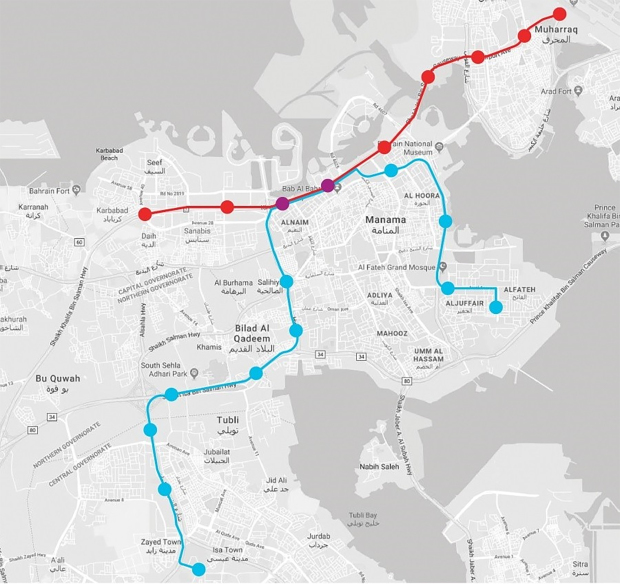
PROCEDURES for the first phase of Bahrain Metro covering 29 kilometres and 20 stations have started, revealed Transportation and Telecommunications Minister Mohammed Al Kaabi.
He told MPs that the first phase would cover Muharraq, King Faisal Highway, Juffair, Diplomatic Area, Seef District, Salmaniya, Adhari and Isa Town.
However, the minister pointed out that the government will purchase parts of 24 plots standing in the way of the Bahrain Metro project.
He added the decision on the purchase of those particular plots is set to be announced shortly, noting that there is no need for huge land acquirement with the project running (suspended) above ground.
Mr Al Ka’abi, who was responding to a question by MP Muneer Suroor on the project, stated that the total cost of the project can’t be provided at the moment with the final bids by the seven qualifying consortiums yet to be provided.
The GDN earlier reported that the project has cost the government BD7.5m until the end of last year and is expected to cost BD11.7m this year and the next as in the 2023-2024 draft budget, and BD91.3m until completion in 2029.
In 2018, Bahrain announced plans to develop a 109-km-long fully-automated, driverless metro system in four phases – estimated to cost around $2 billion.
It would be developed through an integrated public-private partnership in a two-stage process comprising pre-qualification followed by the main tender.
The selected private partner will implement the project with a contract period of 35 years.
“This project is pivotal to the transportation network of the country as it provides a new option that would ease traffic congestion and protect the environment,” said Mr Al Kaabi.
“The electric trains are auto-pilot covering 109km across the country,” he elaborated. “Procedures for the first phase covering 29km and 20 stations have started and they will cover stream arteries such as Muharraq, Isa Town and Juffair.
“The mechanism of implementation for the first phase will be determined in partnership with the private sector through a 35-year concession contract covering design, construction, funding, operation and maintenance as seven consortiums have qualified.”
He added that the tender for the project’s main developer would be issued whenever all final permissions by the ministries and government bodies concerned are granted.
“Parts of 24 plots would be purchased as the project is suspended above ground and a decision on those properties will be announced shortly.
“There is no need for more acquirement.”
The minister also revealed work to link Bahrain Metro with the King Hamad International Station in Al Ramli District is underway and would cover 8km.
“This coincides with work on the King Hamad Causeway between Bahrain and Saudi Arabia that has four lanes for vehicles and two for trains connected through the GCC Railway Network.”
Also in another response to a question on Bahrain Mumtalakat Holding Company by Parliament’s financial and economic affairs committee Mohammed Al Ahmed, Mr Al Kaabi who is politically responsible, said 59 companies are under the sovereign wealth fund’s umbrella.
“Mumtalakat handles asset worth BD3.5 billion under those 59 companies,” said the minister. “Bahrainisation in Mumtalakat and affiliate companies is 73pc, while expats are 27pc.
“Bahrainis in executive posts are 76pc, 78pc are directors and heads, 72pc in specialised and vocational jobs, and 76pc in administrative jobs.”
He explained that the investment strategy sees more partnerships with the local private sector.
“We are exploring potential sectors related food security and healthcare as new investment opportunities.”
Meanwhile, Health Minister Dr Jalila Al Sayyed said in another written reply to a question by Shura Council financial and economic affairs committee vice-chairman Redha Faraj on medicines, that shortages of medications is a regional and international challenge.
“The reasons behind shortages have increased due to the Covid-19 pandemic with raw materials still being unavailable and an export ban still imposed,” she said.
“Some manufacturing factories have closed down and quantities reduced, which has led to increased demand.
“Many manufacturers don’t want their medications registered in Bahrain due to low profitability margins with higher shipping transportation and handling costs.
“But, to ensure medicines that are difficult to import reach Bahrain, the National Health Regulatory Authority (NHRA) is working with the private sector on eased exceptional procedures, that in all wouldn’t violate safety policies.”
She added that medicines were also reaching Bahrain delayed due to order formalities and the need by local agents and manufacturers to get deals for the medicines to reach Bahrain at record times.
“We have formed a national committee for the purchase of drugs and medical equipments, while centralised stores have been established,” said Dr Al Sayyed.
“A drug formulary with all approved medicines under the health insurance scheme has been established with a track system until it reaches patients.”
Mohammed@gdnmedia.bh
&uuid=(email))