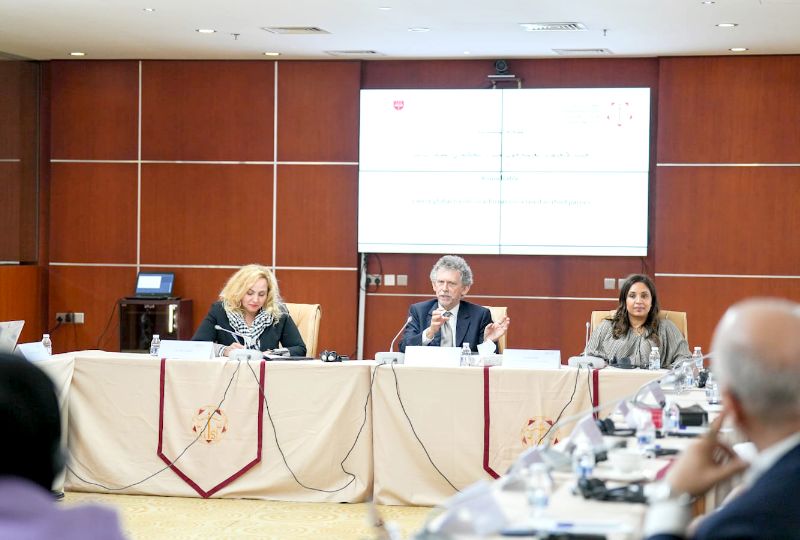
A roundtable discussion was held by the Supreme Judicial Council where renowned international arbitrator and jurist Gary Born discussed the latest global trends regarding the extension of arbitration agreements to third parties.
The event was attended by Supreme Judicial Council vice president and Court of Cassation president Shaikh Khalid bin Ali Al Khalifa as well as a number of distinguished judges from the Bahraini commercial courts.
The roundtable discussion was held at the Judicial and Legal Studies Institute where Mr Born discussed the most significant court decisions and judicial trends in relation to extending the arbitration agreement to non-signatory third parties.
During the discussion, he presented a number of contemporary theories, including economic group theory, which has been particularly popular in cases involving large construction and infrastructure projects. Furthermore, he discussed the judicial application of ‘alter ego’ theory as well as piercing corporate veil theory, a legal concept that combines a corporation’s legal personality and liabilities with its shareholders, thereby holding them personally liable for the company’s debts and obligations. Mr Born explained the applications of these concepts to disputes involving parent companies and subsidiaries.
Mr Born reviewed the basic rules of arbitration procedures stipulated in the United Nations Convention on the Recognition and Enforcement of Foreign Arbitral Awards (New York Convention of 1958), emphasising that the arbitration agreement constitutes the legal basis for resorting to arbitration for the resolution of disputes.