

Bahrain and the UAE lead their GCC peers in terms of economic diversification shows a new report highlighting significant post-pandemic reforms implemented in the two countries.
The Global Economic Diversification Index (EDI) for 2024 report released by the Mohammed Bin Rashid School of Government (MBRSG) at the ongoing World Governments Summit (WGS) in Dubai attributes the success of the two nations to trade liberalisation, investments in technology, and regulatory improvements.
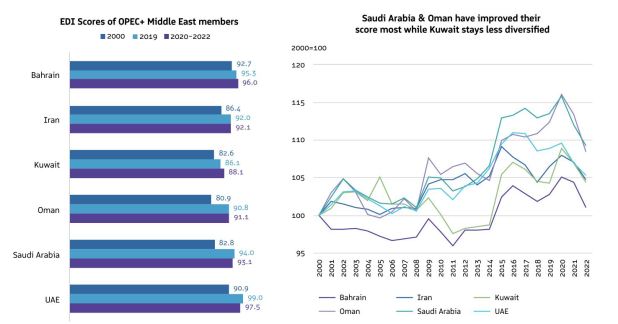
The UAE came out on top scoring 95.7 in 2022, up from 90.9 in 2020. Hot on their heels was Bahrain, with a score of 93.7 in 2022, compared to 92.7 the year before.
The progress shows their governments are actively adapting plans to diversify their economies and move away from oil dependence.
The report also notes that Saudi Arabia and Oman are sprinting ahead having seen the biggest score jumps in the region, gaining over 10 points each since 2020 compared to 2000.
Saudi Arabia’s score surged to 90.5 in 2022, up from 82.8, followed closely by Oman’s jump from 80.9 to 87.7, even as Qatar edged past Oman with an 88.7 score in 2022, and Kuwait came in at 86.2.
Improvements in GCC scores have resulted from the implementation of reforms at a much more aggressive pace after the pandemic.
This includes incentives to invest in new technology sectors, plans to broaden tax bases, trade liberalisation through free trade agreements and improvements to regulatory and business environment and facilitating rights of establishment and labour mobility. These steps have contributed to supporting diversification efforts and providing long-term economic resilience, says the report.
The latest EDI report reveals few changes at the top. The US, China, and Germany continue to reign supreme, holding onto their positions for a decade now.
Western European nations still dominate the top 20, claiming nearly two-thirds of the spots. However, the bigger story lies further down the list. While high-income countries generally rule the top 30, there are some notable exceptions. Countries like China (upper-middle-income), Mexico and Thailand (upper-middle-income), and even India (lower-middle-income) stand out, showcasing impressive diversification efforts. The high-income oil producers like Bahrain, UAE, Norway, Qatar and Saudi Arabia, which had seen improvements in output scores in 2016 and 2019 saw lower scores in 2022: though industrial sector as a percentage of GDP increased, services sector shares slipped due to the effects of the pandemic which negatively impacted the services sectors.
According to the authors, diversification is key for a commodity producing country’s economic development as it enables a gradual move to higher value-added economic activities (from over-dependence on primary commodities) and helps increase its ability to export a wider set of products to a larger set of trade partners.
Stating that although this requires active and productive private sector participation, the report adds that the government has a key role in the form of effective policy reforms and productive investments to be financed by raising non-commodity-related revenues.
Lastly, the report highlights an increasingly important discussion related to climate change and the vulnerability of commodity-dependent nations.
As countries adapt to and mitigate climate change risks, energy transition and ‘green economy’ investments, such as renewable energy, can play a key role in transforming economies and output structures, it suggests.
While fossil fuels won’t vanish overnight, their future is fading, says the study urging oil-rich nations in the Middle East to diversify before the demand dries up.
By diversifying their energy sources, these countries can create new export markets for clean energy products, not just oil. This means more trading partners and a wider range of goods to sell.
Joining forces with other countries in the region will let them share resources and expertise, boosting everyone’s diversification efforts, the report adds.
avinash@gdnmedia.bh
&uuid=(email))