

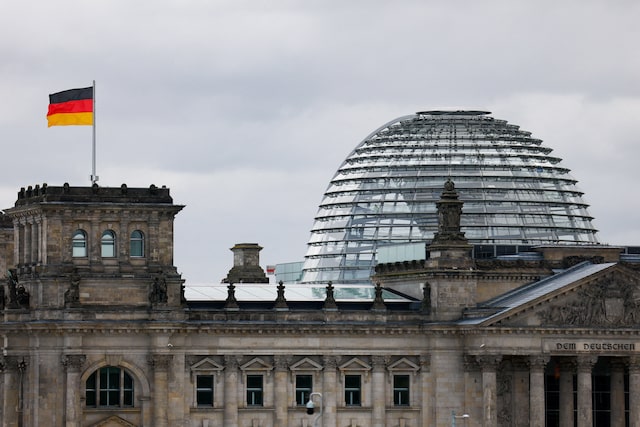
The German government has halved its growth forecast for 2026 and has also cut its growth prediction for 2027, while raising its inflation projections, a source told Reuters yesterday, as the Iran war drives up oil and gas prices.
For this year, the government expects 0.5 per cent growth, down from 1.0pc previously expected, and 0.9pc growth for next year, down from 1.3pc, the source said.
The downward revision follows a cut by Germany’s leading economic institutes, which slashed their joint 2026 growth forecast to 0.6pc from 1.3pc projected in the previous forecasts and lowered their 2027 forecast to 0.9pc from 1.4pc.
The institutes’ forecasts form the basis for the government forecasts.
Europe’s largest economy has been struggling since the pandemic to regain momentum, with increased competition from China as well as higher energy prices – caused first by the Ukraine war and now exacerbated by the Iran conflict – challenging its export-driven economic model.
The Iran conflict is also driving up inflation expectations.
The spike in oil and gas prices following the start on February 28 of joint US-Israeli strikes on Iran has already helped push German inflation to 2.8pc in March. The German government now expects inflation to accelerate to 2.7pc this year and 2.8pc in 2027, the same source said, up from 2.3pc last year.
As inflation increases, household consumption will slow, growing by an estimated 3.2pc in 2026 and 3.3pc in 2027, following a 4.2pc increase last year, the source said.
With tariffs and global uncertainty taking their toll, foreign trade will not be able to support growth for Germany’s export-oriented economy.
&uuid=(email))