

Bahrain has been ranked among the top 20 nations where citizens perceive climate change as less of a threat, with nearly one-third of respondents believing the country is not at risk from its impacts.
According to global safety charity Lloyd’s Register Foundation (LRF), Bahrain ranks fifth globally in terms of the proportion of people who feel unthreatened by climate change.
The data was published in the latest LRF World Risk Poll, included in the report titled ‘What the World Worries About: Global Perceptions and Experiences of Risk and Harm.’
The comparative survey, conducted in 2019 and then in 2023, included 1,007 respondents from Bahrain, a nation classified as ‘high income.’ It revealed a declining concern about climate change among citizens over the years.
When asked about the risk of climate change to people in the country, 30 per cent believed the threat was ‘very serious’ in 2023 – down from 32pc in 2019.
About 22pc said it was ‘somewhat serious’ last year, down from 26pc in 2019, 30pc felt it was ‘not at all serious,’ up from 23pc, and 19pc either did not know or refused to answer on both occasions.
This trend indicates a growing scepticism about the severity of climate change in Bahrain compared to 2019.
Regionally, 36pc of people in the Middle East believe the risk of climate change is very serious, slightly lower than the 39pc global average.
Saudi Arabia leads the list with 46pc of respondents identifying the risk as ‘very serious’, while Ethiopia is second with 39pc and the UAE third with 38pc.
“There is a gap between how people feel about climate change in Bahrain and the level of actual threat,” said LRF evidence and insight director Nancy Hey.
Ms Hey
“Evidence needs to be translated and communicated in ways that are easily understandable and relevant to the public.”
In terms of ‘feeling of safety compared to five years ago’, 13pc of Bahrainis said they felt ‘less safe,’ an increase from 11pc in 2019, 44pc said they felt ‘about as safe’ as five years ago, up from 38pc.
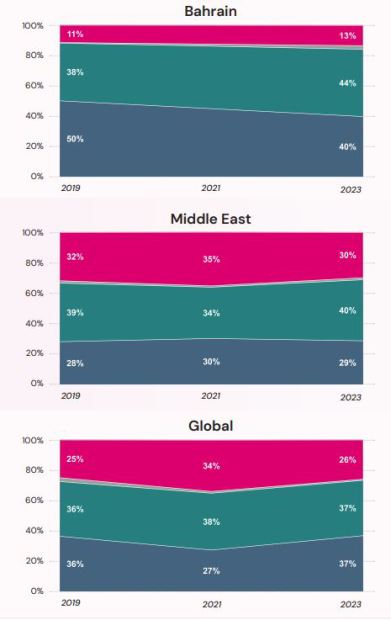
Less people feel safe compared to 2019
Those who felt ‘more safe’ dropped to 40pc, down from 50pc and 3pc either did not respond or did not know.
In comparison, 30pc of respondents in the Middle East and 26pc globally felt less safe than five years ago.
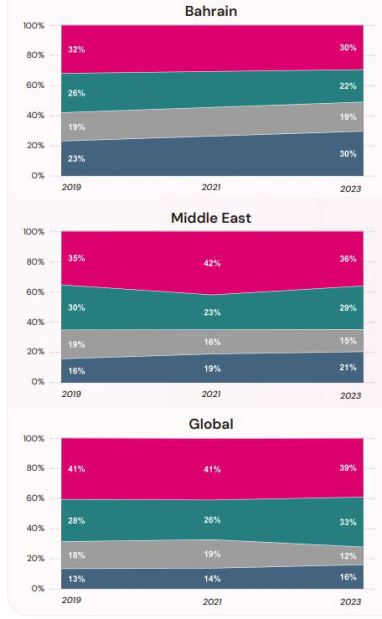
Only 30pc of Bahrainis believe climate change is a risk
When asked about the greatest daily risks to their safety, 19pc of Bahrainis identified economic issues, such as unemployment and high prices as the biggest threat.
Meanwhile, 15pc cited road-related accidents and injuries, 9pc mentioned personal health issues and 4pc pointed to crime and violence.
Bahrain was thus categorised as having ‘Low Relative Worry, Low Relative Experience’ in the Worry Experience Index.
The Human Climate Horizons, a data and insights platform providing localised information on future impacts of climate change, warns of significant climate-related challenges for Bahrain by the end of the century.
The average annual temperature is expected to rise from 27.8C to 32.2C by the end of the century, with temperatures for 227 days a year exceeding 35°C.
Rising temperatures may indirectly lead to increased flooding due to the inability of extremely dry ground to absorb heavy rainfall.
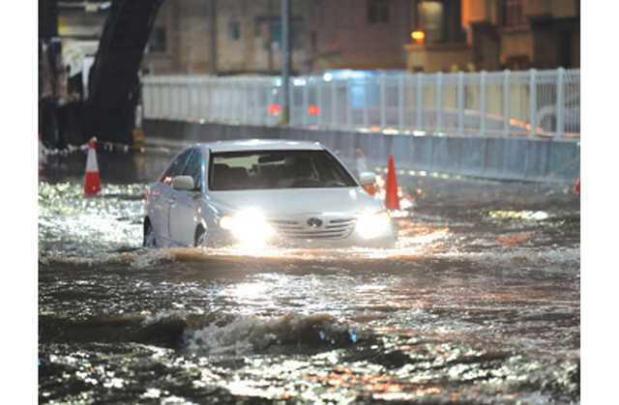
Unprecedented heavy rainfall earlier this year, which caused severe flooding in Bahrain, is believed to have been exacerbated by climate change. In April, the kingdom witnessed its second heaviest downpour since records began, with an average rainfall of 67.6mm recorded in two days.
Additionally, sea levels are expected to rise by up to 60cm by the end of the century, further threatening the nation’s coastal areas.
nader@gdnmedia.bh
&uuid=(email))