Night sky enthusiasts in the kingdom are set for a rare astronomical treat this Sunday when a captivating total lunar eclipse will occur.
The Bahrain Astronomical Society, in collaboration with the Alumni Club, is organising a special public event to mark the occasion.
Starting at 6.30pm at the club’s library hall in Adliya, the gathering will feature detailed lectures on the science of eclipses, live telescope viewing, and a large-screen projection of the phenomenon as it unfolds.
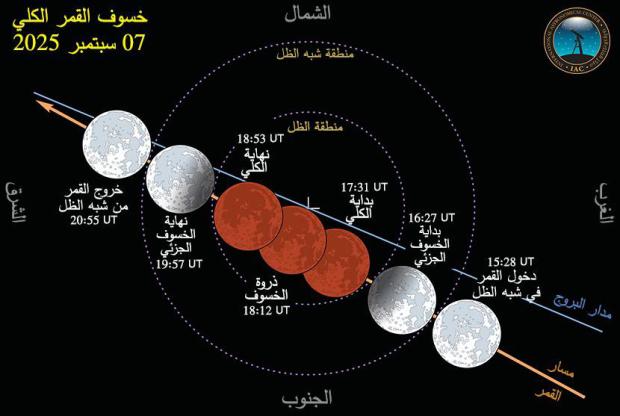
The celestial show begins with partial shading at 7.30pm, while the moon will slip completely into Earth’s shadow from 8.30pm until 9.52pm, producing a breathtaking 82-minute total eclipse. The event concludes at 10pm.
“This is one of the longest total lunar eclipses in recent years,” said Dr Waheeb Al Nasser, professor of applied physics at Arabian Gulf University, who will lead the lecture programme.
“For one hour and 22 minutes, the moon will be entirely in Earth’s shadow – an extraordinary chance for people of all ages to witness the beauty and science of the cosmos.”

Dr Al Nasser
Dr Al Nasser will explain the mechanics of eclipses and their significance in astronomy.
His presentation will cover topics including the link between lunar eclipses and Earth’s curvature, how the event reflects the clarity or pollution of Earth’s atmosphere, and why eclipses only occur when the moon is in its full phase.
“During a total eclipse, the moon does not vanish completely but instead turns a coppery red,” he noted. “This is because sunlight is refracted through the Earth’s atmosphere and scattered, casting a reddish glow. It is a natural filter of our atmosphere, and its hue can even tell us about global air quality at that moment.”
He will also touch on how Muslims historically used the full moon to determine whether lunar months would span 29 or 30 days. “Eclipses connect science, culture and faith,” he said.
“They remind us of the intricate precision of the universe and its influence on human life.”
Joining him will be Dr Mohammed Jassim Al Othman, former professor of astrophysics at Bahrain University, who will explore topics such as lunar months, measuring the speed of light through eclipse observations, and how residents of the southern hemisphere will view the event.
Live telescope observation will be overseen by society members engineer Abdulaziz Zainal, Taqi Al Sayed Mohamed Fadhl, and Abbas Nasr Abbas, who will guide participants through the stages of the eclipse.
The event, open to the public, is designed for both adults and children, with light refreshments provided.
The good thing about all types of lunar eclipses is that, unlike a solar eclipse, they are safe to view with the naked eye. This is because lunar eclipses only reflect sunlight – they don’t get any brighter than a full moon.
Organisers have stressed that if skies are overcast, live viewing will be cancelled, but the theoretical lectures will proceed alongside a broadcast of the event from another location.
Dr Al Nasser urged families not to miss the occasion. “It is not every day that we get such a long total eclipse visible in Bahrain,” he said.
“This is a golden opportunity for our younger generation to witness science in action, to ask questions, and to feel inspired by the wonders of space. Looking up at the sky teaches us humility – that we are part of a much larger universe.”
- To register for the event call 38990011.