

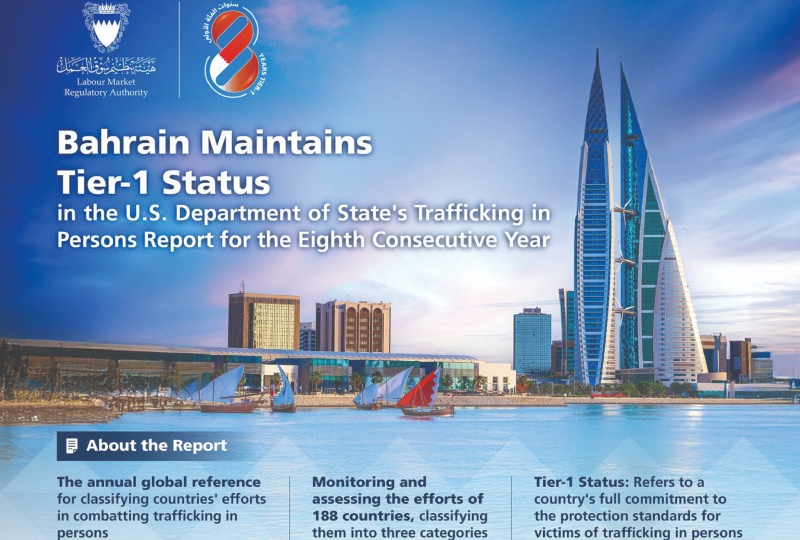
Bahrain has stepped up its anti-trafficking law enforcement efforts with an increase in the number of convictions against traffickers, according to a latest report released by the US State Department.
The Trafficking in Persons (TIP) 2025 report said that the Interior Ministry investigated 44 cases involving 101 alleged traffickers – 12 for sex trafficking and 32 for labour trafficking – compared with 54 investigations in the previous reporting period.
The 25th edition of the annual report features narratives on 188 countries and territories, and covers the period from April 1, 2024 to March 31, 2025.
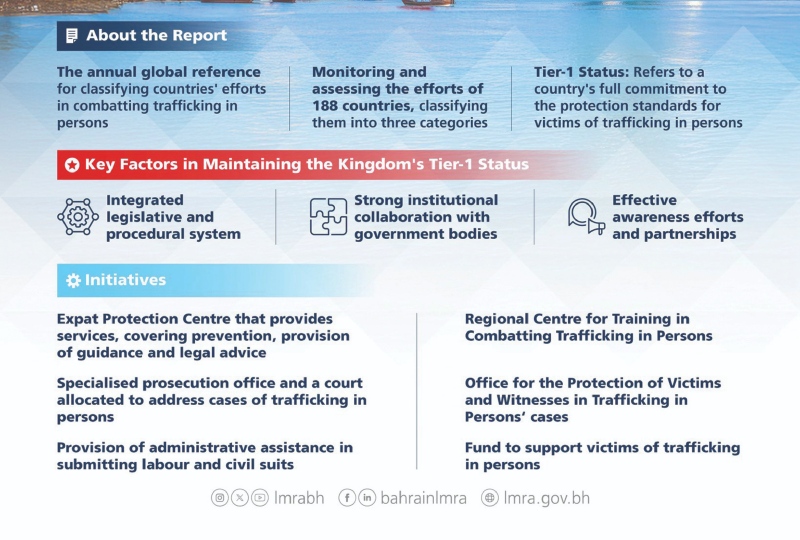
Bahrain maintained its Tier-1 status for the eighth consecutive year in the latest TIP 2025 report released by the US State Department
Bahrain maintained its top ranking in combating human trafficking for the eighth consecutive year, and is placed in the Tier 1 status – the only GCC country recognised as being fully compliant with the Trafficking Victims Protection Act’s (TVPA) minimum standards for elimination of human trafficking.
“The government increased anti-trafficking law enforcement efforts,” said the report.
“Officials prosecuted 48 perpetrators, including 39 alleged sex traffickers in nine cases and nine alleged labour traffickers in five cases, compared with 38 prosecutions in the previous reporting period.
“Courts convicted 55 traffickers, including 46 for sex trafficking and nine for labour trafficking, a significant increase compared with 24 convictions in the previous reporting period.”
The report stated that officials sentenced all traffickers to between one- and 10-years’ imprisonment plus a fine. Upon appeal, four sex traffickers were acquitted of trafficking charges, while 19 sex traffickers’ convictions and five labour traffickers’ convictions were upheld.
“The government required convicted traffickers to pay costs associated with the repatriation of victims and planned to deport all non-Bahraini traffickers upon completion of their sentences,” said the report, adding that no government staff was investigated or convicted in human trafficking crimes.
Investigations into four alleged labour trafficking cases involving seven defendants (including two companies) initiated in previous reporting periods remained ongoing.
The ministry’s Directorate of Criminal Investigation and Forensic Science (CID) maintained a police unit dedicated to trafficking investigations, while the Public Prosecution Office Trafficking in Persons Unit prosecuted all trafficking crimes under the 2008 anti-trafficking law and ensured victims had access to legal recourse and adequate protection services and assistance.
In addition, the Labour Market Regulatory Authority (LMRA)’s Protective Inspection Directorate (PID) referred an unknown number of alleged labour trafficking cases involving 38 potential trafficking victims to the Public Prosecution, while the Grievances and Protections Directorate (GPD) referred three potential trafficking victims to the Public Prosecution for further investigation.
“Of the cases referred to the Public Prosecution by the LMRA involving 41 potential trafficking victims, officials prosecuted at least one labour trafficking case.
“Separately, seven of the 32 alleged labour trafficking cases criminally investigated by law enforcement were referred for prosecution during the reporting period.”
The cover of the TIP 2025 report
Report highlights
The government provided 27 trafficking victims BD1,131 to support their reintegration and offered job placement in Bahrain to victims who desired to remain in the country to work, and provided a new work permit to one labour trafficking victim, the report added.
Furthermore, the LMRA and Interior Ministry’s joint taskforce conducted more than 28,000 inspections, identified 84 potential trafficking victims, referred 38 potential victims to the Public Prosecution and deported more than 5,000 foreign workers.
“Bahraini officials provided comprehensive protective assistance to all official victims regardless of their willingness to participate in criminal justice proceedings and relieved them from all legal and financial penalties related to acts committed as a direct result of being trafficked,” stated the report.
The document added that LMRA’s trafficking hotline received 5,462 calls during the reporting period; hotline staff referred 189 individuals to the Expat Protection Centre in Sehla, while the Interior Ministry’s hotline (555 or 999) received 237 calls, and investigated 18 for trafficking indicators.
In addition, the labour watchdog also reported it received 4,740 claims of unpaid wages from workers during the year, referring 750 to labour courts for litigation. Separately, 505 cases of wage theft were referred to court.
The LMRA further retrieved and returned 812 passports to migrant workers, a significant decrease from 1,719 in the previous reporting period.
“The government reported there were approximately 78,900 domestic workers in Bahrain as of February 2024, 85 per cent of whom were female, predominantly from the Philippines, Ethiopia, India, Indonesia, Kenya, Pakistan and Sri Lanka,” the report stated.
The annual report highlighted a trend indicating that traffickers in countries of origin deceptively recruit skilled workers – including doctors and teachers, mostly from Africa – and upon arriving in Bahrain, force them into domestic work.
Global recognition
Bahrain is the only Gulf country with the Tier 1 status, with five others placed in Tier 2.
The kingdom has constantly moved up in the annual assessment, from being in Tier 3 in 2011 to maintaining a Tier 1 rating since 2018.
The report categorises countries into four sections as mandated by the TVPA, which is the American law against human trafficking.
Tier 1 nations fully meet TVPA standards, while Tier 2 and Tier 2 Watchlist nations do not fully comply with the minimum standards for the elimination of trafficking, though making significant efforts to do so.
Countries not complying with the minimum standards are placed in Tier 3 and subjected to certain US sanctions.
The Bahrain government allocated BD2,091,602 for prevention efforts, an increase compared with BD1,582,404 in the previous report.
“The government continued to demonstrate serious and sustained efforts during the reporting period,therefore, Bahrain remained on Tier 1,” the report said.
“These efforts included prosecuting and convicting significantly more traffickers; identifying more potential victims among vulnerable populations because of targeted screening tools; and creating a task force to co-ordinate efforts to combat labour trafficking.”
Meanwhile, US Embassy chargé d’Affaires Elizabeth Litchfield said yesterday they look forward to build on their strong partnership with the government and the LMRA to further advance these vital efforts.
“We commend Bahrain for once again earning Tier 1 status in the US Department of State’s 2025 Trafficking in Persons Report – its eighth consecutive year at the highest ranking,” the diplomat said.
“This accomplishment highlights Bahrain’s sustained dedication and leadership in the effort to end human trafficking.
“The TIP report seeks to encourage global action and foster co-operation in the shared fight against trafficking in persons.
“US Embassy in Manama looks forward to building on our strong partnership with Bahrain and the Labour Market Regulatory Authority to further advance these vital efforts.”
Prioritised recommendations
1. Expand legal protections for domestic workersnthat are equal to those of private sector workers.
2. Ensure all front-line officials adequately and consistently use screening protocols during law enforcement action, labour inspections and prior to deportations, specifically when encountering vulnerable groups, such as domestic workers who left their employer, migrant workers, and deportees.
3. Fully implement the WPS (wage protection system) to include domestic workers, and ensure officials screen all wage theft cases for other trafficking indicators and refer such cases for criminal prosecution.
4. Prohibit passport confiscation with deterrent penalties that apply to all workers, address concerns of employers “losing” worker’s passports, and train officials to consider passport confiscation as a trafficking indicator.
5. Provide targeted training to law enforcement and prosecutors on trauma-informed and victim-centered practices during court proceedings and when engaging with victims.
6. Fully implement screening procedures for domestic workers upon arrival to Bahrain and ensure household workers sign a contract in their own language and in the presence of a labour official to improve oversight of contract switching.
sandy@gdnmedia.bh
&uuid=(email))