

GCC nations are pivoting towards a strategy of ‘resilience over expansion’ entering 2026, as the region prepares for a global landscape defined by softer oil prices, geopolitical fragmentation, and the rapid transition to an AI-enabled economy.
According to a new regional outlook by PwC, the GCC is moving to insulate its growth from external shocks by deepening global trade integration, securing industrial supply chains, and executing a decisive shift from technology ambition to operational implementation.
In response to evolving global industrial policies and strained US-China relations, GCC states are aggressively broadening their economic networks. Negotiations for Free Trade Agreements with China, the EU, and Japan are advancing, while talks with the UK have entered final drafting stages. The region is increasingly positioning itself as a central hub for east-west trade through the India–Middle East–Europe Economic Corridor (IMEC).
To support domestic manufacturing, securing critical minerals has become a strategic priority. Saudi Arabia’s Ma’aden and the UAE’s ADQ are forming global partnerships to secure upstream access in Africa and Asia, while simultaneously developing domestic midstream refining capacity for battery metals and rare earth elements to participate more meaningfully in global value chains.
After years of heavy infrastructure investment, 2026 is expected to mark the transition from government-led AI pilots to broad-based commercial deployment. A regional compute bottleneck is easing as major GPU clusters come online, including the commencement of Stargate UAE and Saudi Arabia’s integration of advanced NVIDIA Blackwell chips.
This infrastructure surge is being met with regulatory clarity, as streamlined permitting allows data centres to reach operations in nearly half the time required in the US or Europe. Furthermore, several GCC states are expected to expand data sovereignty requirements, mandating that sensitive government and financial workloads run on domestic ‘sovereign cloud’ infrastructure.
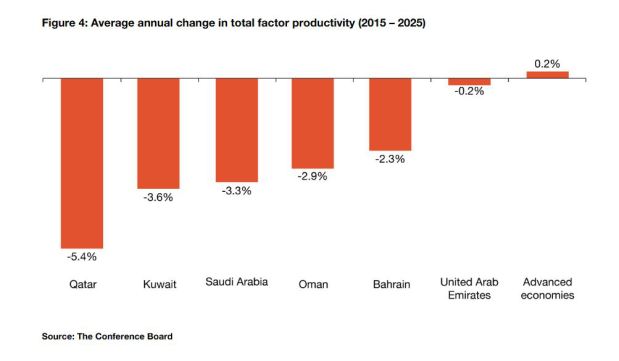
To reverse a decade of weakening total factor productivity, regional labour market policy is shifting from simple job creation to managing active workforce transitions. Governments and employers are scaling short, modular training programmes and micro-credentials in data analytics and digital operations to equip workers for emerging roles.
Workplace-based learning and apprenticeship-style pathways are becoming more common as firms integrate AI tools into daily workflows. This is supported by sophisticated public-private talent platforms, such as Qatar’s Ouqoul and the UAE’s Emirati Smart Human Resource Platform, which use real-time data to match national workforces with reskilling opportunities and new job categories like AI model operators and risk specialists.
With oil prices forecasted to average $55-60 per barrel in 2026, regional governments are intensifying their focus on expenditure discipline and private capital mobilisation. Fiscal policy is pivoting toward the monetisation of state-owned assets in logistics, utilities, and desalination to redirect funds toward higher-impact investments.
While borrowing via sukuk and sustainability-linked bonds is expected to increase to fund strategic deficits, the focus remains on strengthening non-oil revenue frameworks. This includes the implementation of domestic minimum top-up taxes in the UAE and Kuwait and broader energy subsidy reforms, ensuring that the region’s long-term transformation remains sustainable despite tighter hydrocarbon receipts.
PwC Middle East economic policy and strategy partner Jing Teow said: “Having already mobilised capital and policy at scale, GCC governments are now focused on delivery. In 2026, the priority is strengthening economic resilience through more secure trade and investment relationships, effective AI deployment, managed workforce transitions and disciplined fiscal policy in a more challenging and fragmented global environment.”
avinash@gdnmedia.bh
&uuid=(email))