

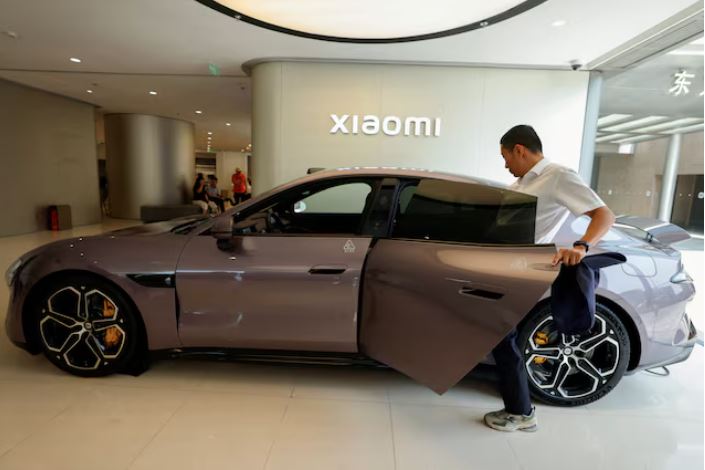
China's Xiaomi began taking pre-orders on Wednesday for an upgraded version of its SU7 model, aiming to boost the popularity of the company's best-selling electric sedan in the highly competitive Chinese market.
Xiaomi's announcement comes as it faces increased public criticism over safety standards following a number of accidents. Other EV makers including Xiaomi's rivals Tesla and BYD have also come under scrutiny after accidents and recalls.
The new-generation SU7 is set to hit the market in April, with lidar remote sensing as a standard feature and a range of up to 902 km (560.48 miles), Xiaomi's CEO Lei Jun said in a Weibo post on Wednesday.
Pre-sales start at 229,900 yuan ($32,891.72), 6.5% more than the inaugural version introduced in March 2024 but still 2.4% cheaper than Tesla's Model 3.
In contrast with previous sales campaigns, Xiaomi stressed safety and downplayed the vehicle's speed.
"Safety is the basis and premise," Lei wrote.
Sales of the SU7, with a maximum range of 830 km, have so far exceeded 360,000 vehicles, or an average of 17,000 units per month.
Xiaomi, which also sells the YU7 SUV, has set an EV sales target of 550,000 vehicles for this year after sales topped 410,000 units in 2025.
SU7 sales have been on a downward trend since August, and it was outsold in China by Tesla's Model 3 in September and November.
Xiaomi has built a leading position in sectors from smartphone to EVs with the support of hardcore fans who have rallied around Lei, one of China's most successful entrepreneurs.
But the company started to attract criticism after two fatal accidents last year involving Xiaomi EVs. Authorities have said that they are still investigating the incidents. Lei has said Xiaomi would respond to concerns but accused online trolls of smearing the company.
Lei held a livestream event on Saturday to dismantle Xiaomi's YU7 SUV in an attempt to showcase the vehicle's build quality, but the stunt prompted a backlash with viewers questioning some of the company's claims.
On Monday, the new communications head, Xu Jieyun, issued a public apology for committing what he said was a public relations blunder, without elaborating. A Chinese blogger known for being a staunch critic of Xiaomi had said earlier that Xiaomi had offered him a cooperation contract.
Xiaomi did not respond to Reuters queries about the public criticism of the company.
&uuid=(email))