

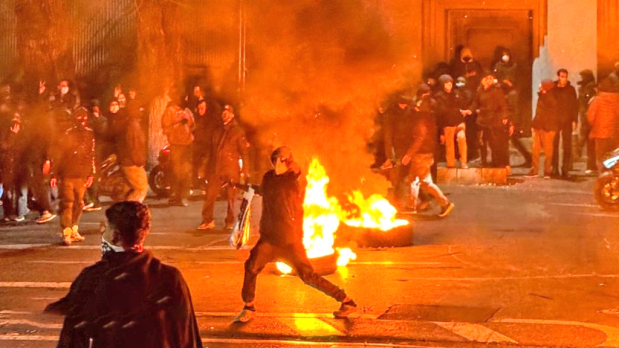
With Iran’s anti- government unrest evolving rapidly and foreign pressure mounting, the clerical establishment appears unable, for now, to tackle what has become a crisis of legitimacy at the heart of the Islamic Republic.
The demonstrations, which began in Tehran last month, have spread to all of Iran’s 31 provinces and at least 60 protesters, including nine children, have been killed by Iranian security forces.
Starting in Tehran with shopkeepers in the Grand Bazaar angered by a sharp slide in the rial currency, the latest protests now involve others – mainly young men rather than the women and girls who played a key role at the Amini protests.
Iran suffered a nationwide Internet blackout on Thursday, which Internet monitoring group NetBlocks said extended into yesterday. It coincided with calls from abroad for more protests from Reza Pahlavi, the son of Iran’s last shah who was toppled in the 1979 Islamic revolution.
“The collapse is not just of the rial, but of trust,” said Alex Vatanka, director of the Iran Programme at the Middle East Institute in Washington DC.
Nearly five decades after the Islamic Revolution, Iran’s religious rulers are struggling to bridge the gap between their priorities and the expectations of a young society.
“I just want to live a peaceful, normal life … Instead, they (the rulers) insist on a nuclear programme, supporting armed groups in the region, and maintaining hostility towards the United States,” Mina, 25, told Reuters from Kuhdasht in the western Lorestan province.
“Those policies may have made sense in 1979, but not today. The world has changed,” said the jobless university graduate.
“Enough is enough. For 50 years this regime has been ruling my country. Look at the result. We are poor, isolated and frustrated,” said a 31-year-old man in the central city of Isfahan.
A former senior official from the establishment’s reformist wing said the Islamic Republic’s core ideological pillars – from enforced dress codes to foreign policy choices – did not resonate with those under 30 – nearly half the population.
“The younger generation no longer believes in revolutionary slogans – it wants to live freely,” he said.
The hijab, a flashpoint during the Amini protests, is now being enforced selectively. Many Iranian women now openly refuse to wear it in public places – breaking with a tradition which has long defined the Islamic Republic.
In the ongoing protests, many protesters are venting anger over Tehran’s support for militants in the region, signalling frustration at the establishment’s priorities.
People clashed with security forces in Tehran’s Grand Bazaar and cheering protesters marched through Abdanan, a city in southwestern Ilam province, other videos verified by Reuters this week showed.
In a video from the northeastern city of Gonabad, young men were seen rushing out of a seminary mosque to join a large crowd of protesters cheering them on in an apparent revolt against the clergy.
Vatanka said the Iranian clerical system had survived repeated protest cycles by repression and tactical concessions but the strategy was reaching its limits.
“Change now looks inevitable; regime collapse is possible but not guaranteed,” he said.
US President Donald Trump has repeated his threats to attack Iran if it continues to use violence against protesters. He warned Iran’s leaders on Friday night: “Better not start shooting because we’ll start shooting too.”
A former Iranian official said there is no easy way out for Supreme Leader Ayatollah Ali Khamenei, whose decades-old policies of building proxies, evading sanctions and advancing nuclear and missile programmes appear to be unravelling.
&uuid=(email))