

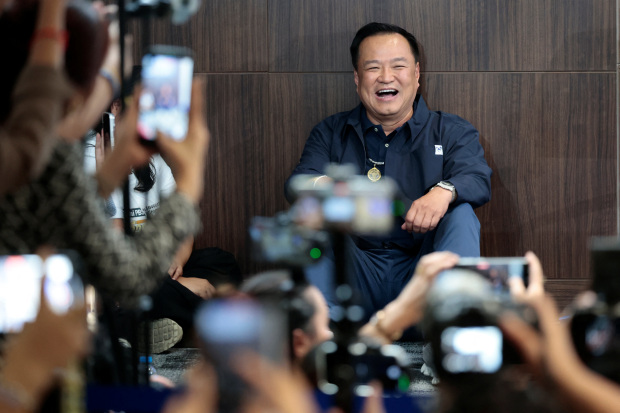
Thailand faced a realignment of conservative politics on Monday, with coalition talks expected to start soon after Prime Minister Anutin Charnvirakul's party clinched a stronger-than-expected general election victory. With 94% of votes counted, the ruling Bhumjaithai was way ahead of its rivals after Sunday's vote, securing 193 of the 500 seats in parliament, according to Reuters' calculations based on election commission data.
"We need a strong government," Anutin said in a news broadcast, adding that he wanted to form an administration with a strong majority but was waiting for the final results.
The result drove stocks up 4% in Southeast Asia's second-largest economy, to their highest level in over a year, as the risks of political instability receded and the finance minister vowed to pursue existing stimulus plans.
NEW BLOW TO PROGRESSIVES
The left-leaning People's Party, which led most opinion polls in the run-up to the vote, trailed with 118 seats, marking a setback for a party whose forerunner, Move Forward, won the 2023 election before it was blocked from forming a government.
In a further blow to the People's Party on Monday, the National Anti-Corruption Commission announced its investigation had found 44 former Move Forward members had breached ethical standards by seeking to amend a royal defamation law in parliament in 2021.
The 44 included 10 People's Party seat winners from Sunday's election, among them leader Natthaphong Ruengpanyawut and deputy leader Sirikanya Tansakun.
The commission, which has a broad remit, in a statement said it would forward the case to the Supreme Court. The court could suspend them from duty as lawmakers while it deliberates the case and they face political bans if found guilty.
Bhumjaithai received 30.2% of constituency votes on Sunday and also took a string of seats from the once-dominant Pheu Thai, controlled by the billionaire Shinawatra family, which was third on just 74 seats. A combined 115 seats went to a handful of other parties.
ANUTIN PROMISES BORDER WALL; STIMULUS PLANS RETAINED
Anutin said the outcome was "a victory for all Thais". He called the election in December after less than 100 days in office, seeking to ride a wave of nationalism generated by Thailand's three-week conflict with Cambodia in December, a gamble that paid off, enabling him to consolidate the conservative vote.
Underscoring the role nationalism played in the vote, Anutin vowed to build a wall along Thailand's border with Cambodia and strengthen the military.
"I will still have to build the wall," he added.
Facing economic challenges ahead, Anutin previously indicated that if re-elected, he would retain the incumbent ministers of finance, foreign affairs and commerce in a new cabinet.
The new government will proceed with existing stimulus plans, including the second phase of a subsidy scheme to cut living costs, Finance Minister Ekniti Nitithanprapas said.
"It will build on the previous policies ... and will focus more on investment," he said, adding that the government would pursue long-term measures to "make it big and win".
Growth could fall below 2% this year as the Thai economy grapples with problems ranging from an appreciating baht currency to U.S. tariffs and high household debt.
VOTERS BACK CONSTITUTIONAL CHANGE
Voters also backed a proposal to change the constitution, with nearly two-thirds in favour of replacing a charter adopted after a 2014 military coup that critics say gave too much power to an undemocratic Senate.
Adopting the new constitution is expected to take at least two years and Anutin vowed not to delay the work.
"The government will act according to the people's will," he said.
&uuid=(email))