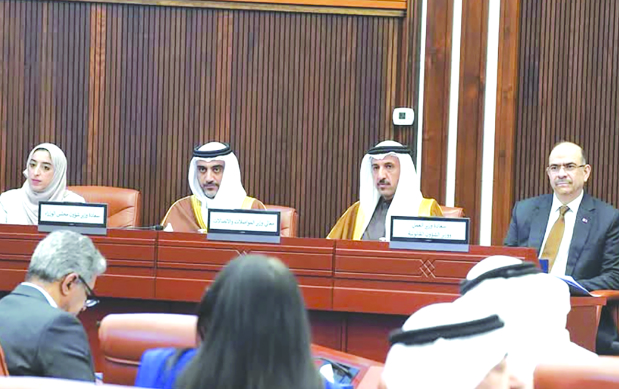
Four ministers have reaffirmed that tourism, aviation and logistics are now central pillars of Bahrain’s economic diversification strategy, unveiling ambitious plans and strong performance indicators that underline the kingdom’s growing regional and international competitiveness.
Tourism Minister Fatima Al Sairafi said the tourism sector has become ‘a main engine for economic diversification’, stressing that the national strategy is embedded within Bahrain’s Economic Recovery Plan because of its direct impact on job creation and growth.
She explained that tourism now constitutes seven per cent of the total GDP. “The World Tourism Index report issued in January 2026 showed that Bahrain ranked third in the Middle East for visitor growth in 2025 compared with 2024, achieving an 11 per cent increase,” she told MPs. “This reflects tangible progress resulting from close co-operation between government entities and our private-sector partners.”
Since the launch of the tourism strategy in 2022, 23 new four- and five-star hotels have been developed, a clear sign of investor confidence in the Bahrain market.
“Tourism in Bahrain is no longer only regional – it is international,” Ms Al Sairafi said. “We have partnerships with more than 100 travel agents and are targeting markets such as the GCC, China, the UK, India and Germany. Bahrain is promoting itself independently, but also as part of a joint ‘one Gulf destination’ vision.”
She highlighted growing momentum in business tourism, conferences and exhibitions, particularly at Exhibition World Bahrain, alongside festivals, coastal tourism, beaches, heritage attractions and diverse tourism products.
On tourist guides, Ms Al Sairafi said Bahrainis account for more than 70pc of licenced guides and that licences for nationals are issued free of charge.
“We are reviewing the decision regulating the profession to further strengthen the priority for national competencies, while also considering the needs of some markets that require specialised languages and expertise,” she added.
Transportation and Telecommunications Minister Dr Shaikh Abdulla bin Ahmed Al Khalifa said developing aviation and tourism is a ‘cornerstone for strengthening the national economy and creating quality jobs for citizens’.
“Airports are the front door of any country, and aviation directly supports economic growth, global connectivity and employment,” he said. “Bahrain’s aviation ecosystem is among the oldest in the region, with a history of more than 75 years, giving us strong accumulated expertise despite intense regional competition.”
He announced the launch of the National Aviation Strategy 2026-2030, built on four main pillars, including integrated development of the airport, services, legislation, supply chains and logistics – not airlines alone.
Dr Shaikh Abdulla confirmed that Bahrain has succeeded in attracting AirAsia, Asia’s largest low-cost carrier, to establish a regional base in the kingdom after strong regional competition.
“AirAsia is the size of seven airlines combined, carrying tens of millions of passengers. This gives Bahrain the edge we need,” he said. “We also expect several aircraft to be registered in Bahrain in the coming years, which will boost air traffic, tourism and job opportunities.”
He added that agreements have been signed with specialised companies in aircraft maintenance, logistics and air cargo, including the establishment of advanced maintenance hangars, alongside efforts to attract e-commerce and freight companies.
On maritime connectivity, Dr Shaikh Abdulla said work is under way to enhance cruise and marine tourism and to develop sea transport services to improve safety and passenger experience.
Labour and Legal Affairs Minister and Acting Minister for Parliament and Shura Council Affairs Yousif Khalaf said the government is focused on developing these sectors through ‘futuristic, long-term plans that will create vast and lasting opportunities’.
“All policies are being aligned with Bahrain Economic Vision 2030 to ensure tangible outcomes for citizens, whether in employment, training or investment,” he said.
Meanwhile, Cabinet Affairs Minister Hamad Al Malki revealed that the airport operator has recently advertised around 400 jobs on the national employment platform.
“About 90pc of pilots and airport employees are currently Bahrainis, and we are working to raise this percentage further, including in reception and ground services,” he said.
Mr Al Malki also pointed to the success of diversification, noting that in the third quarter of 2025, financial and insurance activities contributed 17.8pc of GDP, manufacturing 16.1pc, while oil and related activities accounted for 15pc – no longer the largest share.
Services committee chairman Mamdooh Al Saleh, who led the 10 MPs requesting the general debate on Bahrain’s competitiveness as a regional tourism and aviation hub, spoke first.
“Bahrain has a strategic location, a modern airport and a national carrier with long experience,” he said. “What we need now is a clear, co-ordinated policy that maximises these strengths and turns transit passengers into actual visitors who contribute to the local economy.”
He stressed that thousands of passengers pass through Bahrain International Airport daily.
“If even a small percentage choose to spend 24 or 48 hours in Bahrain, this would generate significant returns for hotels, restaurants, transport providers and small businesses,” Mr Al Saleh said.
MP Jalal Kadhem Al Mahfoodh said the unified GCC tourist visa represents a major opportunity to boost intra-Gulf tourism and position the region as an integrated destination.
“Bahrain must prepare proactive plans to capture a larger share of tourist flows moving between GCC countries,” he said, calling for stronger investment in heritage sites and museums as well as launching a comprehensive marine tourism project linking Bahrain with neighbouring states.
He praised the integration between the Transportation and Telecommunications Ministry, Tourism Ministry, Interior Ministry, Youth Affairs Ministry and Tamkeen, saying successful events such as ‘Muharraq Nights’, ‘Hawa Al Manama’, Formula One and the heritage city in Askar demonstrate what Team Bahrain can achieve.
“All these efforts reflect a shared national responsibility,” Mr Al Mahfoodh added, “to strengthen Bahrain’s position, diversify the economy and create sustainable opportunities for citizens.”
mohammed@gdnmedia.bh