

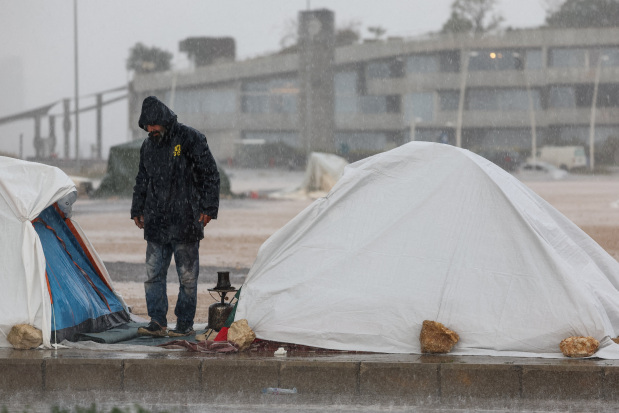
Hussain Murtada and his family are camping in the back of a small truck, a flimsy tarpaulin shielding them from a storm yesterday, with no room left at shelters for displaced people in the southern Lebanese city of Sidon.
“We are putting tarp over it because we’re soaked,” said Murtada, using string to fasten the plastic sheet over the back of the truck parked on the seafront. Inside, an infant peered out, surrounded by pillows, blankets and other possessions.
“I asked here at the schools and they are full, they’re all full,” said Murtada, who fled the town of Hanawiya, some 12 km from the border with Israel, with his family of seven.
More than 800,000 people, around 15 per cent of Lebanon’s population, have had to flee their homes since Israel began an offensive in the country after the Lebanese Hizbollah group opened fire at Israel in support of its ally Iran on March 2.
It has dragged Lebanon into the Middle East conflict just 15 months since the last Israel-Hizbollah war.
Only a fraction of the displaced – some 132,000 according to Lebanese authorities – are in collective shelters.
The rest are scattered elsewhere, some with relatives, others in half-finished buildings or host communities and many in the streets.
Mohammad Marie, who fled the city of Nabatieh in southern Lebanon, has been sheltering under a tree on Beirut’s seafront Corniche, protected by a plastic sheet before it was blown away.
The United Nations launched a $308 million flash appeal on Friday to help Lebanon cope with the fallout of the war.
Israeli attacks have killed 850 people and wounded more than 2,100 others in Lebanon since March 2, including 107 children and 66 women, the Lebanese health ministry said yesterday. Its toll does not say how many of the casualties were combatants.
Two Israeli soldiers have been killed in southern Lebanon, while no fatalities have been reported in Israel as a result of Hizbollah rocket and drone attacks since March 2.
Israel and Lebanon are expected to hold talks in the coming days aimed at securing a durable ceasefire that would see Hizbollah disarmed, two Israeli officials said yesterday, though the timing and terms have yet to be agreed.
Beirut is forming a delegation for talks but no date has been set.
Lebanon needed clarity on whether Israel would abide by President Joseph Aoun’s first point – a demand for a full ceasefire to allow negotiations to take place, three Lebanese officials said on Saturday.
Read more:
16 killed in Gaza and West Bank
US officials predict quick end to Iran war
GCC and UK stress need for diplomacy to curb Iran actions
&uuid=(email))