

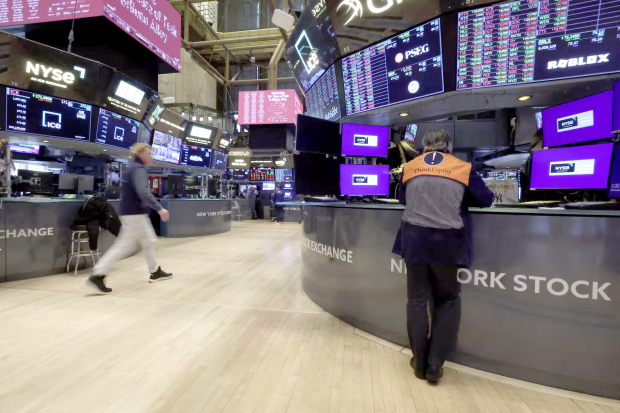
US equity indexes closed modestly higher and US oil futures settled above $112 per barrel yesterday as investors waited for clarity on the prospects of a resolution to the war in the Middle East.
The US and Iran exchanged verbal attacks while President Donald Trump reiterated threats to strike Iran unless Tehran makes a deal by tonight.
Iran said it wanted a lasting end to the war with the US and Israel, and pushed back against pressure to reopen the Strait of Hormuz.
Still, investors drew some comfort from a report that indicated the US, Iran and a group of regional mediators are discussing the terms for a potential 45-day ceasefire.
“The optimism is coming from talks about a ceasefire in Iran. March was a tough month for stocks and investors really just want to find a reason to be optimistic,” said Melissa Brown, managing director of investment decision research at SimCorp.
“That’s the driver of today’s optimism but could turn into tomorrow’s concern quickly.”
The S&P 500 financial index was the biggest boost, up 0.7 per cent, with JPMorgan Chase and Visa in the lead. These stocks also lifted the blue-chip Dow.
Tech stocks followed, with chip-linked firms among the top gainers. Memory chipmaker Seagate rose 6.6pc after Morgan Stanley added it to its top-pick list. The Philadelphia SE Semiconductor index was up 0.9pc.
“The expectation is that tech earnings will continue to be good ... if the stocks have been beaten down, maybe this is a buying opportunity,” said Brown.
Mining and healthcare stocks fell 0.6pc and 0.3pc, respectively, capping gains.
At 11.50am, the Dow Jones Industrial Average rose 83.20 points, or 0.18pc, to 46,587.48, the S&P 500 gained 16.71 points, or 0.25pc, to 6,599.40 and the Nasdaq Composite gained 88.32 points, or 0.40pc, to 21,967.50.
Trading volumes yesterday were expected to be thin as many markets in Europe and Asia are closed for public holidays.
Wall Street’s main indexes posted their first weekly gains in six weeks on Thursday, as the prospects of an end to the conflict soothed investor nerves.
Markets will scrutinise domestic inflation readings this week to gauge if the conflict-driven spikes in energy prices have trickled into the US economy.
Friday’s data showed US job growth rebounded more than expected in March, helping the Federal Reserve to focus on its inflation mandate.
Money market participants are not pricing in any easing from the central bank this year, compared to two cuts they had expected before the war broke out, per CME Group’s FedWatch Tool.
Yesterday, the Institute for Supply Management’s non-manufacturing purchasing managers’ index for March came in at 54, slightly below estimates of 54.9, according to economists polled by Reuters.
Among others, Soleno Therapeutics shares surged about 32pc after Neurocrine Biosciences agreed to acquire the rare-disease drugmaker for $2.9 billion in cash.
US-listed shares of cryptocurrency-linked firms rose, with Coinbase and Strategy up 2.8pc and 5.7pc, respectively, as bitcoin prices edged higher.
Advancing issues outnumbered decliners by a 1.44-to-1 ratio on the NYSE and by a 1.74-to-1 ratio on the Nasdaq.
The S&P 500 posted seven new 52-week highs and one new low, while the Nasdaq Composite recorded 46 new highs and 50 new lows.
In currencies, the dollar index, which measures the greenback against a basket of currencies including the yen and the euro, fell 0.37pc to 99.89, with the euro up 0.33pc at $1.1553.
Against the Japanese yen, the dollar strengthened 0.09pc to 159.7. The yen had flirted with the crucial 160 per dollar level after Japanese Finance Minister Satsuki Katayama on Friday put currency traders on notice, saying the government stands ready to act against speculative moves in foreign exchange markets as volatility has risen “significantly.”
The yield on benchmark US 10-year notes fell 1.3 basis points to 4.333pc, from 4.346pc late on Friday while the 30-year bond yield fell 1.6 basis points to 4.8897pc.
The 2-year note yield, which typically moves in step with interest rate expectations for the Federal Reserve, was flat at 3.852pc, from 3.852pc late on Friday.
On Friday, while Wall Street markets were closed for the Good Friday holiday, the US jobs report showed that employment growth rebounded more than expected in March, with a 178,000 increase in nonfarm payrolls representing the biggest increase in more than a year. The unemployment rate fell to 4.3pc from 4.4pc, as people dropped out of the workforce.
The data complicates the picture for the Federal Reserve, which will next decide on monetary policy at a two-day meeting ending on April 29. However, traders are not pricing in any rate cuts from the U.S. central bank until October 2027, according to the CME Group’s Fedwatch tool.
Citing uncertainty around inflation and heightened geopolitical risks tied to the Middle East war, Wells Fargo Investment
Institute said on Monday that it no longer expects a Fed rate cut in 2026 compared with its previous forecast for two cuts this year.
In precious metals, gold was little changed while silver dipped as market participants cautiously awaited further signals on the evolving U.S.-Iran situation and its impact on global interest rates.
Spot gold rose 0.1pc to $4,680.29 an ounce and spot silver fell 0.37pc to $72.71 an ounce.
&uuid=(email))