

GCC-LISTED banks achieved record-breaking aggregate revenues of $37.4 billion in the final quarter of 2025, according to a new sector report by Kamco Invest that analysed 56 regional lenders.
The 1.7 per cent sequential growth in the top line was primarily driven by consistent lending activity and higher net interest income, even as yields on credit faced downward pressure.
However, the sector’s bottom line told a different story. Net profits for the quarter declined by 5.9pc to $15.6bn – a four-quarter low. Analysts attributed this dip to a sharp rise in impairments, which reached their highest level in 18 quarters, alongside a second consecutive quarter of rising operating expenses.
The revenue surge was bolstered by strong performances from banks in Bahrain, Saudi Arabia, Kuwait, and Oman. Conversely, listed banks in the UAE and Qatar saw marginal declines in their top-line figures.
In terms of profitability, Oman was the sole market to buck the downward trend, while all other GCC nations saw a contraction in net profits as banks fortified their balance sheets against potential risks.
The report highlighted the resilience of the regional non-oil sector, which continues to fuel demand for credit.
Aggregate gross loans reached a record $2.47 trillion, marking a 2.7pc quarterly increase.
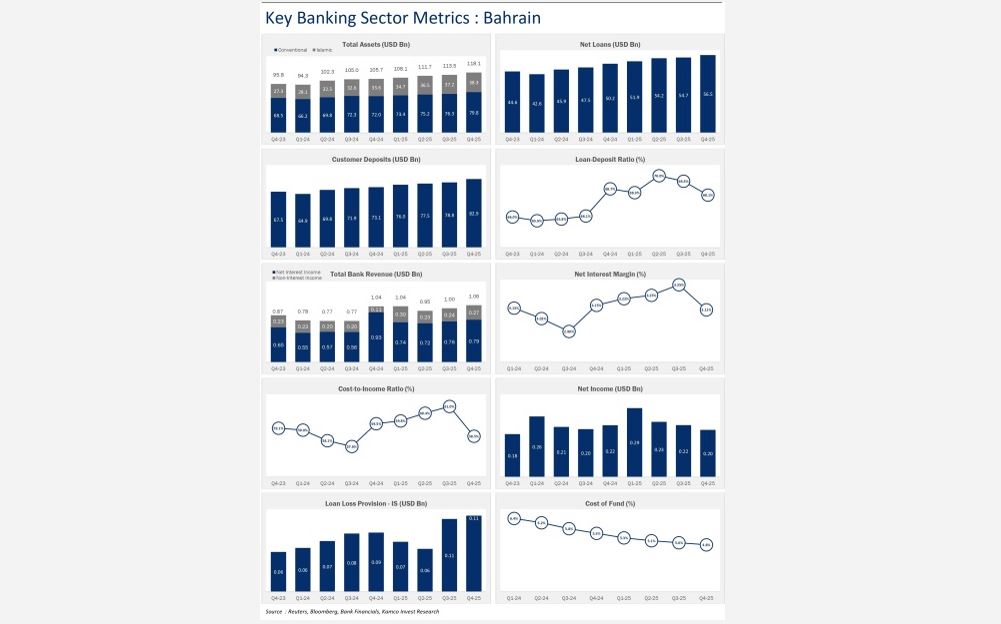
After the UAE, Bahrain achieved the second-highest percentage growth in credit offtake at 1.78 per cent (up BD227.3m), with other service activities expanding 14.13pc (up BD106.9m) and government borrowing increasing 5.63pc (up BD40.6m).
The business sector also contributed positively with 1.37pc growth (up by BD75.1m). Mining (down 14.05pc and BD13.2m) and construction (down 5.25pc and BD24.6m) were the key detractors.
Personal and consumer lending remained a dominant driver across the UAE, Qatar, Kuwait, and Oman, reflecting sustained household confidence.
For the first time in 19 quarters, customer deposits saw a sequential decline (0.6pc), falling to $2.78trn. This pushed the regional loan-to-deposit ratio to a record high of 85.4pc, up from 82.8pc in Q3-2025.
The financial landscape is currently navigating a ‘higher-for-longer’ interest rate environment. While late 2025 saw a cycle of rate cuts by the US Federal Reserve, persistent inflation and geopolitical instability in the Middle East have forced a hawkish shift.
Central banks in the GCC are expected to maintain their alignment with the US Fed’s path to protect currency pegs. The report noted that while headline inflation remains a concern due to volatile energy prices, core inflation has remained relatively stable.
To counter regional instability, GCC central banks have implemented precautionary measures.
“The Central Bank of Bahrain and the Central Bank of Oman have focused on operational resilience and rigorous business continuity planning to ensure stability and uninterrupted credit flow during periods of geopolitical tension,” the report added.
Islamic banks outperformed their conventional counterparts in lending growth during the quarter, posting a 3.7pc increase compared to the 1.7pc seen in conventional banking institutions.
avinash@gdnmedia.bh
&uuid=(email))