

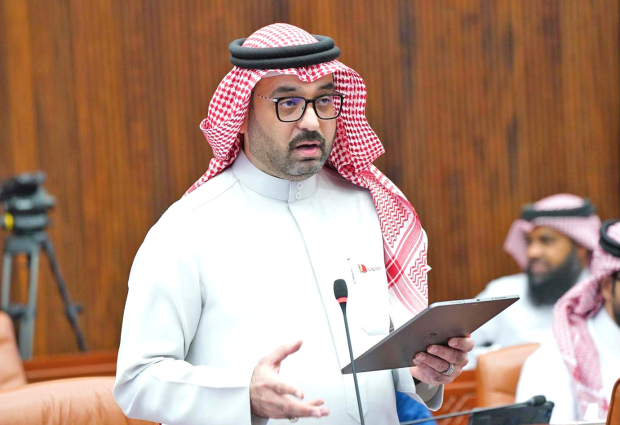
Bahrain is set to deepen its international economic integration as MPs prepare to approve two government-drafted laws – accession to the Locarno Agreement and ratification of amendments to the Organisation of Arab Petroleum Exporting Countries (OAPEC) agreement that will transform it into the Arab Energy Organisation.
Both drafts were endorsed by Parliament’s financial and economic affairs committee and are scheduled for debate on Tuesday.
Committee chairman MP Ahmed Al Salloom said the two moves reflect Bahrain’s strategy of aligning its laws with evolving global standards in innovation and energy.
“These are technical agreements, but their impact is strategic,” he said. “One strengthens how we protect industrial creativity and innovation, and the other modernises Arab co-operation in a sector that is rapidly transforming beyond oil.”
The first draft approves Bahrain’s accession to the Locarno Agreement, which establishes a unified international classification system for industrial designs used by intellectual property offices worldwide.
The Industry and Commerce Ministry told MPs the step would streamline registration and examination procedures, improve transparency, and bring Bahrain in line with global best practice in industrial property protection.
By adopting the Locarno Classification, Bahrain’s system for registering designs – from consumer products to manufacturing components – will be aligned with international standards used across dozens of countries.
“This supports innovation, improves the business environment and enhances Bahrain’s competitiveness as a knowledge-based economy,” Mr Al Salloom said.
The second draft ratifies amendments approved by OAPEC’s Council of Ministers in December 2024 to restructure the body into a broader Arab Energy Organisation covering all energy fields, not just petroleum.
The revised agreement expands the organisation’s mandate, restructures its bodies, modernises dispute resolution mechanisms and attaches a detailed protocol on immunities and privileges for the organisation and its staff.
According to the Oil and Environment Ministry, the changes are designed to keep pace with transformations in the global energy sector and enhance joint Arab projects, investment opportunities and data exchange.
MPs were told Bahrain’s annual contribution of BD210,000 will remain unchanged after the amendments.
“The restructuring allows the organisation to operate across renewable energy, electricity and emerging technologies, not just oil,” Mr Al Salloom said. “This is crucial as the region adapts to new energy realities.”
The Sustainable Development Ministry confirmed the energy agreement does not conflict with Bahrain’s Sustainable Development Goals, while the Electricity and Water Authority had no objections.
The legislative and legal affairs committee also confirmed the constitutionality of both drafts and their accompanying agreements.
Mr Al Salloom stressed that Parliament regularly reviews Bahrain’s commitments to international organisations to ensure value for money and strategic relevance.
“These agreements are not ceremonial,” he said. “They position Bahrain within modern systems of innovation protection and future-focused energy co-operation.”
&uuid=(email))