

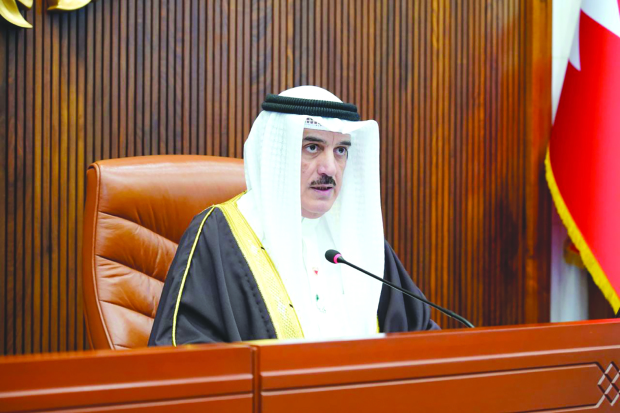
Proposed amendments to Parliament’s internal regulations could significantly ease the process for MPs seeking to question ministers and advance their cases.
The draft law amends key provisions of Parliament’s Bylaws issued under Decree-Law No 54 of 2002 and has received full government backing after being referred by Deputy Prime Minister Shaikh Khalid bin Abdulla Al Khalifa.
MPs are expected to vote on Tuesday to refer the proposals to Parliament’s legislative and legal affairs committee for review, in what is being described as one of the most consequential procedural reforms to parliamentary oversight in recent years.
At the heart of the amendments are two changes that could dramatically alter how interpellations – the most powerful questioning tool available to MPs – are handled inside the chamber.
Under the current rules, an interpellation can stall at committee level if it fails to secure a high approval threshold from MPs when the committee’s report is presented to the chamber.
The proposed change lowers this bar. The committee’s report on the seriousness of the interpellation will now be put to a vote without debate at the first session following its preparation, and the interpellation will proceed if it secures a simple majority of Parliament members – 21 MPs rather than two thirds – 27 MPs.
Legal drafters explained that the previous requirement – effectively demanding a higher quorum – created procedural obstacles that could prevent interpellations from progressing, even before the substance of the questioning was heard.
According to the explanatory memorandum prepared by the Legislation and Legal Opinion Commission, this creates a ‘logical progression’ in parliamentary tools, ensuring that an interpellation can move to the chamber stage without being blocked by technical voting hurdles.
The second major change is introduction of a formal mechanism allowing interpellations to be discussed in a closed session.
Such a session may be requested by the government, Parliament Speaker, or at least 10 MPs. The request itself must be discussed and voted on in a closed sitting. If MPs reject it, the interpellation proceeds in a public session.
This provision is rooted in Article 65 of the Constitution, which allows the internal regulations of Parliament to determine how interpellations are debated, including whether they are held publicly or privately.
The explanatory note argues that, in certain cases, confidentiality provides ‘the most complete guarantee of objectivity’, shielding proceedings from media pressure and social media speculation, and allowing MPs and ministers to engage in calm, substantive discussion.
Crucially, the final decision on secrecy remains with Parliament itself.
In a formal opinion note, the government said the amendments reflect “best procedural practices” and strike a balance between strengthening oversight and ensuring orderly public work. The amendments were originally proposed by MPs led by Speaker Ahmed Al Musallam last month to “develop the oversight performance entrusted to Parliament” and enable members to use their constitutional tools more effectively.
Mr Al Musallam says the reform could mark a turning point in how ministers are held to account under the interpellation system, making it a more practical and usable oversight instrument rather than a rarely-completed process.
&uuid=(email))