

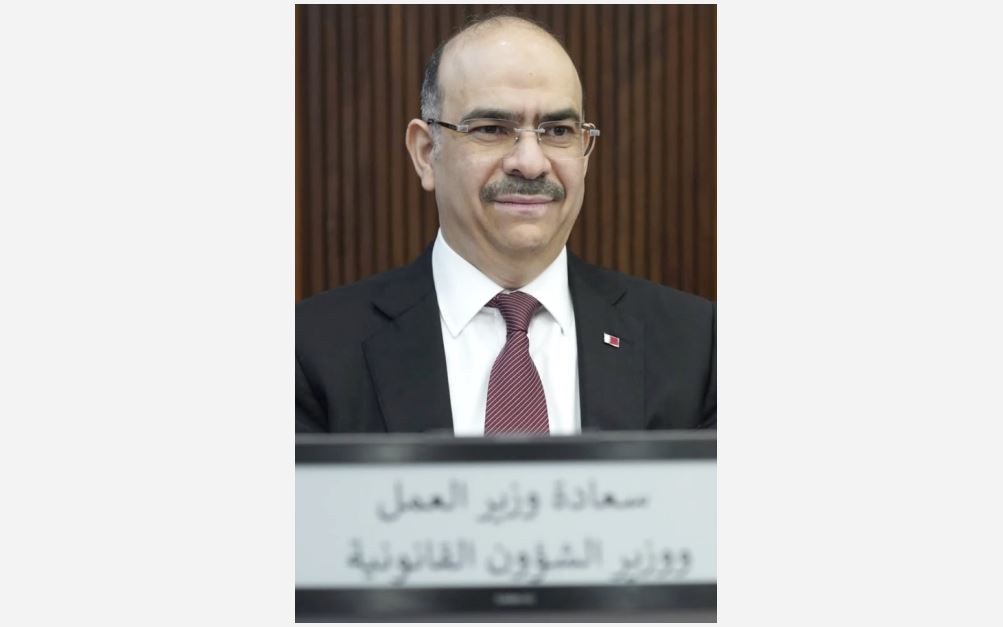
A tense Parliament session turned into a deep legal and statistical examination of how Bahrain handles disability employment, labour data and wage support, as Labour and Legal Affairs Minister Yousif Khalaf faced a wave of questions from six MPs yesterday.
What began as criticism over a ‘delayed decision’ under a 2006 disability law quickly widened into a broader debate over who actually holds enforcement powers, why employment figures appear to shift, and how far the government can push private firms on wages without hurting business sustainability.
At the heart of the exchange was Article 12 of Law No 74 of 2006 on the Care, Rehabilitation and Employment of Persons with Disabilities. MPs questioned why a formal decision identifying government jobs reserved on a priority basis for qualified people with disabilities had not been issued.
Mr Khalaf responded with a firm legal clarification: the responsibility under the law rests primarily with the Social Development Ministry – not Labour.
“The definition of ‘minister’ in this law refers to the Social Development Minister,” he said. “Judicial enforcement powers are also vested in that ministry.”
He disclosed that a priority list of government job titles for people with disabilities has already existed since November 6, 2023, prepared jointly by the Civil Service Bureau and the Social Development Ministry.
“The issue is not the absence of a list or a legal vacuum,” he said. “The list is there and is being applied. The Labour Minister’s role comes after the list is finalised and tested in practice.”
Responding to allegations that hundreds of firms are breaching disability hiring quotas without consequence, Mr Khalaf explained that non-compliance is not automatically a criminal offence within Labour Ministry powers.
“A violation occurs if a company fails to post vacancies on the National Employment Platform, or if discrimination is proven after interviews,” he said. “If we detect irregularities, we refer them to the Social Development Ministry, which has authority to refer cases to the Public Prosecution.”
He added that the National Employment Platform is designed with two job categories: posts exclusively for people with disabilities and others open to all jobseekers.
The minister also addressed accusations of conflicting labour market statistics, saying employment data is inherently dynamic and linked to several government databases including the Information and eGovernment Authority, the Social Insurance Organisation and the Labour Market Regulatory Authority.
He cited a directive issued on September 28, 2025, by His Royal Highness Prince Salman bin Hamad Al Khalifa, Crown Prince and Prime Minister, to offer three job opportunities to every registered jobseeker.
“At that point, there were 17,831 registered jobseekers,” he said. “We employed 4,746 people, but new registrations continued. This is a moving database, not a fixed number.”
On wages, Mr Khalaf highlighted the delicate balance between ensuring Bahrainis earn a decent living and protecting private sector sustainability.
“This balance is essential. Disturbing either side creates labour market instability,” he said. He pointed to wage support programmes run by Tamkeen, which temporarily subsidise part of salary increases before employers gradually absorb the cost.
“The programme has shown strong participation from employers and employees,” he added, noting plans for further expansion without harming Bahrainisation efforts.
Earlier, MP Mohammed Al Maarafi criticised the ministry’s written reply as ‘shocking’ and argued the Article 12 decision should have been issued years ago. He cited figures showing 1,589 vacancies against 288 disabled jobseekers and claimed only 376 out of 1,455 establishments were compliant.
Other MPs raised concerns about enforcement, transparency of figures and the daily realities facing families of people with disabilities seeking work.
Mr Khalaf closed by saying the legal framework, data systems and employment mechanisms were ‘clear as the sun’, while welcoming MPs’ scrutiny as part of improving services.
&uuid=(email))