

Emergency water drills, similar to fire or earthquake mock exercises, need to be organised to change consumer mindsets and reinforce the importance of water conservation in the region, according to an expert.
During these drills, members of the public would be expected to set strict but temporary limits on water consumption to help safeguard long-term supplies.
Such measures are particularly important in the current geopolitical climate, where water infrastructure, including desalination plants, have become the prime targets of drones and missiles from Iran, Arabian Gulf University’s Water Resources Management Professor Waleed Zubari said.
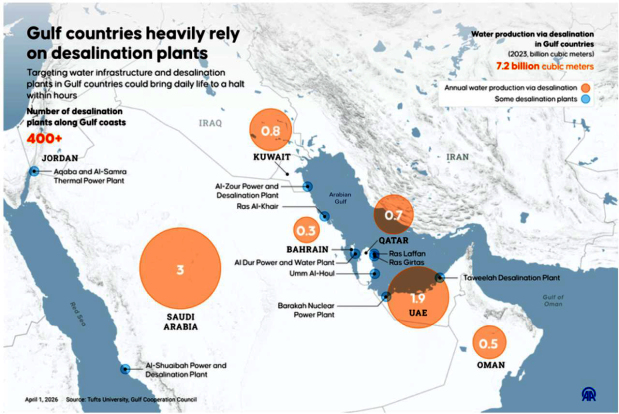
Bahrain, Kuwait, Oman, Qatar, Saudi Arabia, and the UAE together produce around one‑third of the world’s desalinated water and host many of its largest desalination plants.
The six GCC countries have a combined population that the United Nations estimates surpassed 61 million last year.
Since the start of the US‑Iran‑Israel conflict on February 28, Tehran has targeted critical infrastructure, striking a desalination plant in Bahrain on March 8 and, causing material damage. The Doha West Power and Water Desalination Station in Kuwait was damaged by debris from intercepted drones and missiles on March 2.
Further incidents were also reported, notably Iranian drone strikes on April 5 that inflicted significant damage on Kuwait’s power and water facilities and led to the death of Santhanaselvam Krishnan, a 37‑year‑old Indian national.
“The GCC’s water supply systems face unprecedented threats with near-total reliance on desalination plants drawing feed water from the Arabian Gulf,” Mr Zubari explained to the GDN.

Mr Al Zubari
“Our lifeline is exposed to hazards ranging from oil spills, toxic algal blooms, cyberattacks, military strikes to the catastrophic risk of radioactive contamination from Iran’s Bushehr nuclear facility.”
Conservation vital
He said every Gulf state has a national emergency preparedness plan focused on supply-side measures, strategic reserves (reserves measured in days, held in underground or above-ground reservoirs), groundwater backups, bottled water stockpiles and households’ storage, among others.
However, according to Mr Zubari, the most critical link during this heightened environment is missing and remains underdeveloped.
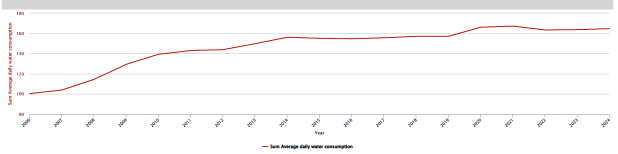
A graph shows the gradual increase in the average daily water consumption in Bahrain from 2006 to 2024
“The first missing link is consumer rationing behaviour that needs to be checked, as I feel there is a strategic oversight,” he said.
“During a crisis, the behaviour of hundreds of thousands of households can dramatically alter the resilience of the entire system. Household behaviour can extend reserves dramatically. For example, a country with a 10-day strategic water supply, under normal consumption patterns, will indeed last only 10 days.
“But under a disciplined emergency rationing regime, that same volume could be stretched to over a month, providing precious time to water supply authorities to fix the system.”
Mr Al Zubari said mere lip service will not change the consumer pattern, as it requires education, training, and practice.
“We need to institutionalise a culture of water drills—similar to fire or earthquake drills—where citizens learn how to reduce consumption drastically during an emergency. Societies that value water and use it efficiently in normal times are far more resilient in crises than those who don’t.
“Rationing is the last line of defence, but conservation is the first.”
Early warning system
The second missing link pointed out by the expert was the need for a joint infrastructure and early warning systems on a regional level
He added that the present GCC co-operation on water during emergencies was commendable but still limited – as it involves exchanging experiences or sharing spare parts and consumables during emergencies.
“This is not enough,” explained Mr Zubari. “The Arabian Gulf is a shared body of water, and a threat to its quality is a threat to every member state.”
He said the setting up a joint Early Warning System for Seawater Contamination is vital – whether the contaminant is an oil slick, a toxic algal bloom, or even gravely radioactive material from a nuclear incident in Iran.
“No single country can detect and respond fast enough alone. A co-ordinated, real-time monitoring network across the Gulf should be established,” he noted.
“The logical home for this unit would be the recently established ‘GCC Disaster Management Centre’ in Kuwait, which could serve as the regional ‘nerve centre’ for seawater quality intelligence.”
He said the Centre should start by prioritising ‘water’ and co-operating with existing UN agencies such as the Regional Organisation for the Protection of the Marine Environment (ROPME) in Kuwait and the Marine Emergency Mutual Aid Centre in Bahrain.
Access to water is protected under the laws of armed conflicts, and the United Nations Sustainable Development Goal (SDG) 6 is to ‘ensure availability and sustainable management of water and sanitation for all’.
GCC water grid
Another protection measure, he said, would be a GCC water grid to ensure supplies between neighbouring countries during a crisis, especially for the smaller GCC states, namely Bahrain, Kuwait, and Qatar, which have limited areas and groundwater resources.
“While a full regional grid is a long-term vision, the immediate path forward is bilateral water gridding,” he said.
Neighbouring countries should establish joint technical committees to conduct comprehensive feasibility studies for cross-border interconnections.”
Mr Zubari said some GCC states have already initiated such discussions and formed committees, which is a step in the right direction.
“I think we must cultivate a culture of conservation and emergency rationing, drill our societies to respond under pressure, and invest in joint early warning and grid infrastructure, and the current conflict makes it imperative to act now.”
Bahrain’s average daily water consumption reached 164.6 million imperial gallons in 2024, which was a slight increase from 163.75m imperial gallons in 2023.
Some of the measures suggested by Mr Zubari have also been highlighted in a 10-point action plan proposed by the Saudi-based Gulf Research Centre that calls upon the six GCC states to use the current critical pause during the Iran ceasefire to assess their water infrastructures.
“The conflict has demonstrated a dangerous trend in modern warfare: the weaponisation of water infrastructure,” the report states.
“By targeting desalination facilities, parties to the conflict are pursuing strategies that risk a regional humanitarian catastrophe.”
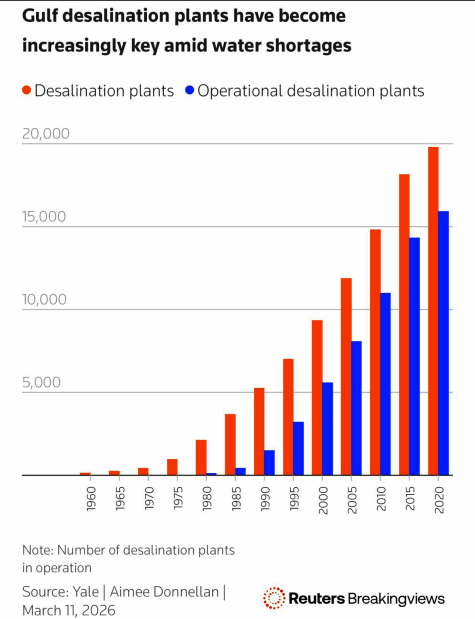
A graph shows the gradual increase in the number of desalination plants over the years operational in Gulf countries.
It says that experts have warned that if major desalination plants were to be fully disabled, some Gulf cities could face a humanitarian crisis within a week, necessitating mass evacuations.
“The likelihood of such a scenario must be taken seriously,” the report warns.
Bahrain approved the National Water Strategy 2030 in 2018, aligned with the GCC Unified Water Strategy (2016–2035), with the objective of ensuring the sustainable and efficient management of water resources.

Bahrain’s overview in achieving UN’s SDG Goal Six: Ensure availability and sustainable management of water and sanitation for all
Continuous development of the water supply networks has increased water storage capacity to approximately 2.6 million cubic metres, sufficient to meet national water demand for more than four days, under normal conditions, in the event of a complete shutdown of all production plants.
sandy@gdnmedia.bh
READ MORE:
&uuid=(email))