

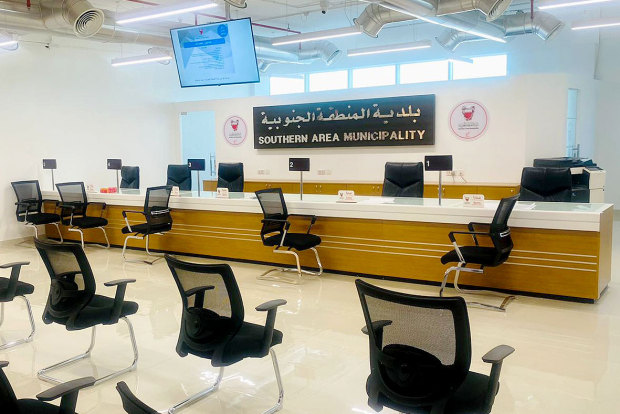
Councillors are calling for the standardisation of municipal fees on homes across Bahrain, arguing it would ease household costs, improve payment compliance and simplify administration.
The proposal by councillor Hamad Al Zoubi was unanimously approved by the Southern Municipal Council and referred to Municipalities Affairs and Agriculture Minister Wael Al Mubarak for review.
It seeks to unify municipal fees on residences at a fair minimum rate for citizens, replacing the current system where charges vary depending on property classifications, land area, building size and rental value under Resolution No 22 of 2000 and earlier schedules.
Councillor Hamad Al Zoubi said the idea was driven by the need to reduce living burdens while ensuring ‘a more consistent and transparent approach’ to fee collection.

Mr Al Zoubi
“We are looking at a system that is easier for residents to understand and fairer in how it is applied,” he said.
“Unifying the fee at a reasonable level for homes will directly reduce pressure on families, increase purchasing power and, importantly, encourage more people to pay on time instead of avoiding or delaying payment.”
He pointed to regional examples to support the proposal.
“In Abu Dhabi, reducing municipal fees led to higher overall revenues within two years because compliance increased,” he said. “When people feel the system is manageable, they are more willing to commit to it.”
Mr Al Zoubi stressed that the proposal does not seek to weaken municipal revenues, but to strengthen the relationship between residents and the system.
“When the fee structure is simple and perceived as fair, compliance rises and financial evasion drops,” he said. “This benefits both citizens and the municipality.”
Financial, administrative and legislative committee chairman councillor Khalid Shajra said the committee examined the legal and financial dimensions of the proposal in light of the powers granted to municipal councils under Decree-Law No 35 of 2001, which allows councils to propose the imposition and amendment of municipal fees.
.jpg)
Mr Shajra
“The current structure is based on multiple schedules that take into account land area, building size and rental value. While administratively sound, it creates noticeable differences between households,” he said.
“The proposal aims to reduce these disparities by introducing a unified approach for residences that achieves equality while maintaining the municipality’s ability to provide services.”
He added that simplifying the system would also make it easier for councils to manage collections and reduce alleged disputes related to calculations.
Mr Shajra confirmed that the committee unanimously supported forwarding the recommendation, describing it as a practical step towards modernising how municipal residential fees are applied.
Southern Municipality director-general Isa Abdulrahman Al Buainain explained that municipal fees fund essential services provided daily to residents.
.jpg)
Mr Al Buainain
“These fees cover waste collection and transportation, cleaning of public areas, and management of public facilities and landmarks,” he said.
“The current calculation method is based on fixed standards linked to property data, which makes it administratively practical. Any move towards unification would need to preserve fairness, ease of application and continuity of service delivery.”
He noted that while items such as waste bags are considered organisational tools rather than chargeable services, the core municipal services tied to fees remain consistent across residential areas.
The council’s decision now places the proposal before the minister for further study, with members hopeful that a unified fee model could bring relief to households while maintaining the sustainability of essential municipal services.
mohammed@gdnmedia.bh
&uuid=(email))