

An arts-and-crafts enthusiast is so committed to her hobby that she acquired a full-sized traditional Bahraini loom, set it up in her home in Busaiteen, and uses it to make textiles.
Shaikha Showaiter picked up weaving seven years ago at a government-sponsored workshop and has since explored fibre arts from far and wide such as tricot, talli, naqda, sadu and crochet.
Unlike the few weavers remaining in Bahrain today, who inherited the skills and profession from a parent or relative, the 35-year-old Bahraini does not have a familial connection to the practice.
Instead, she picked up the ancient craft of weaving as an adult at the hands of Bani Jamra weavers Habib and Saleh Al Jamri, through a programme run by Bahrain Authority for Culture and Antiquities (Baca) in 2019.
The wooden handloom was custom-built by weaver Abdulhussain Najem, better known as ‘Abu Essam’, who installed it in Ms Showaiter’s living room himself.
Unlike the looms at the Bani Jamra Textile Weaving Factory, which are anchored to the floor, and whose operators sit in recessed pits, Mr Najem’s machine can be moved, and allows the weaver to sit on a chair.
“I wanted to keep my hands busy with something, and weaving kept my mind clear, and my hands off the phone!” the artist told the GDN. “It ended up being my safe space, where I can be with my thoughts. At the beginning, I wanted to make things to sell and display but I decided to keep it for myself and create things I want.”
Right now, she is making curtains for her sunny living room, that doubles as her art studio. The room is also a space where her friends gather to work on their different crafts in each other’s company.
The crafting enthusiast gave the GDN team a demonstration of the process, moving her hands and feet in a synchronised fashion while she interlaced horizontal and vertical threads to create a powerful piece of cloth.
Ms Showaiter comes from a well-known sweets-making family, whose name has become synonymous with Bahraini halwa, but stated that her family’s creations were not just limited to desserts.
“Besides halwa, my uncles did wood carving and carpentry and my grandmother also practised naqda,” she said. “I was always interested in arts-and-crafts. Growing up, I learned through watching YouTube, but what is special about traditional crafts is that you really have to be taught by an artisan.”
Her weaving journey began as part of a Baca programme in 2019, in which various types of Bahraini crafts were taught. The goal was for the participants to create hand-made items that could be displayed at Expo 2020.
“After Baca gave us that opportunity, I felt a push to continue my craft, to learn more, to be exposed to more art,” she explained. “I discovered that textile arts exist, and it expanded my view of what an artist is.
“I learned all the textile arts that I was able to, including traditional sadu weaving, which is the technique that Bedouins use to make tents.
“I explored crochet and knitting, but they weren’t my thing. I also learned embroidery, which I really loved and enjoyed. I tried my hand at sewing, basket-weaving and a little bit of naqda (embroidery using silver or gold thread) but I was attached to weaving the most.”
In Bahraini handlooms, vertical threads, known as the warp, are stretched across the floor or a wooden frame. The operator uses foot pedals to lift half of the threads, making an opening that horizontal threads, known as the weft, can be passed through.
Ms Showaiter told the GDN that the most special thing about traditional crafts is that you cannot learn them by yourself: you need someone to teach it to you, in order to learn it properly. She believes that connecting with people is very important in today’s world. “I got to meet many people that work with their hands, and they taught me in a loving way.
“In Bahrain, most people want to give you their knowledge, just for the sake of sharing their knowledge. It’s ‘zakat al elm’ – the charity of learning.”
The artist told the GDN that battling with sickle cell disease (SCD) and clinical depression had often stopped her from doing the things she loved. “You lose interest in creating when you’re depressed,” she revealed.
“Being ill did not allow me to continue learning and producing more. I needed to take some time to understand myself, go to therapy and to try a different kind of medication until I felt well enough to return to my craft.”
For now, Ms Showaiter will continue working on the curtains. Although they will take time, she said that it is not only about the end result, but enjoying the journey.
zainab@gdnmedia.bh
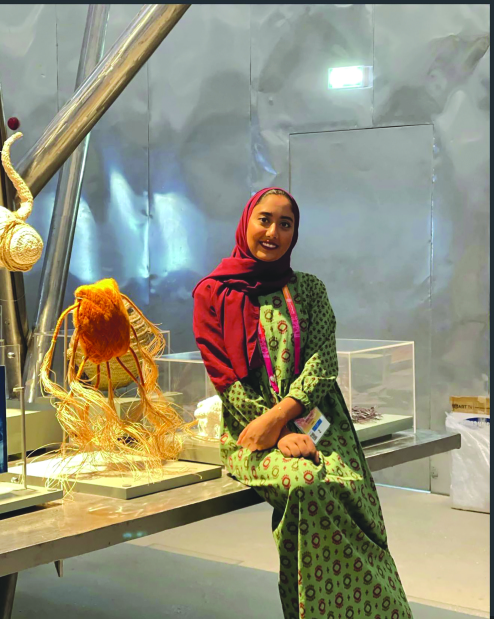
Ms Showaiter with her creation – a feather tail fish – in Expo 2020, as part of the Dilmun Cabinet of Curiosities display
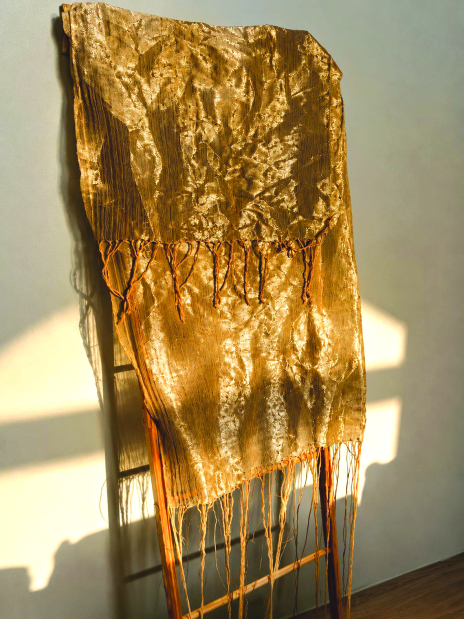
A piece of fabric Ms Showaiter weaved using zari (golden thread)
&uuid=(email))