

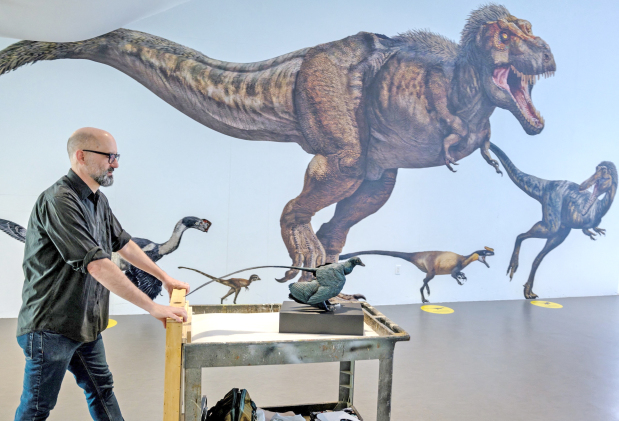
Everyone knows dinosaurs got really big. Some of the long-necked plant-eaters were the largest land animals ever on Earth, as shown by Argentinosaurus, perhaps 70 to 90 tonnes and upwards of 100 ft long. But how about tiny dinosaurs, like the size of a mouse? As far as we know, none ever existed.
New research investigates this phenomenon. Scientists employed mathematical models to explore the evolution of body size across vertebrate groups.
They determined that energetics and physiology can account for the sizes of mammals, birds that fly and turtles, but these factors fail to explain the absence of really small dinosaurs, aside from their avian descendants.
The researchers see other dynamics at play. They hypothesised that because early mammals – most of them puny shrew-sized critters – had ably filled ecological niches for small animals, their presence prevented dinosaurs from evolving tiny body sizes adapted to such niches.
“We know based on observations of living animals and the fossil record that most animal groups have members that achieve very small body sizes, and that these small animals typically dominate their ecosystems,” said palaeontologist Stephanie Lechki, a postdoctoral fellow at Princeton University in New Jersey and co-leader of the study published in the journal Evolution.
“A small animal typically requires fewer resources and can achieve reproductive maturity and reproduce more quickly than a large-bodied animal,” Lechki said.
The smallest dinosaurs included the likes of crow-sized Microraptor, weighing as little as 430 grams; Fruitadens, at 730gm; and Anchiornis, at 530gm.
These were still much larger than today’s smallest bird, the bee hummingbird (about 1.75gm); smallest mammal, the Etruscan shrew (about 1.8gm); and smallest lizard, the dwarf gecko (about 0.15gm).
“Most living species are small, much smaller than us, and smaller than even the smallest dinosaurs,” said palaeontologist and study co-leader Roger Benson, curator of dinosaur paleobiology at the American Museum of Natural History in New York.
That includes approximately 90 per cent of extant bird species and 75pc of extant mammal species.
“Think of rodents, shrews, bats, songbirds, most lizards, frogs, so many small species. This suggests that there are many more niches available to small-bodied species. The absence of tiny dinosaurs means that all those abundant niches were closed to them,” Benson said.
Dinosaurs first appeared roughly 230 million years ago and eventually became the dominant land animals, holding that status until an asteroid struck Earth 66m years ago, causing a mass extinction of species.
Mammals during the age of dinosaurs thrived in ecological niches perfect for small body sizes like insectivores and seed eaters.
“It is likely that small-bodied early mammals outcompeted dinosaurs, preventing them from reaching small body sizes. Similarly, large dinosaurs likely outcompeted early mammals, preventing them from reaching large body sizes,” Lechki said.
It was only after the asteroid struck that mammals achieved larger body sizes and expanded into ecological niches previously occupied by dinosaurs like large plant eaters and apex predators.
Another potential explanation for the lack of evidence for tiny dinosaurs is that they did exist but their fossils have been elusive.
&uuid=(email))