

POLE Leo arrived in Argentina from Uruguay yesterday for the second leg of a 12-day tour across South America, ahead of a closely watched speech to Argentine President Javier Milei, a libertarian seen as a close ally of US President Donald Trump.
The address by the first US-born pope may underscore tensions between the Vatican and Milei, whose austerity agenda has been criticized by the Church for hitting the poorest hardest. The Argentine leader has also strongly supported the Iran war, which Leo has denounced to Trump’s ire.
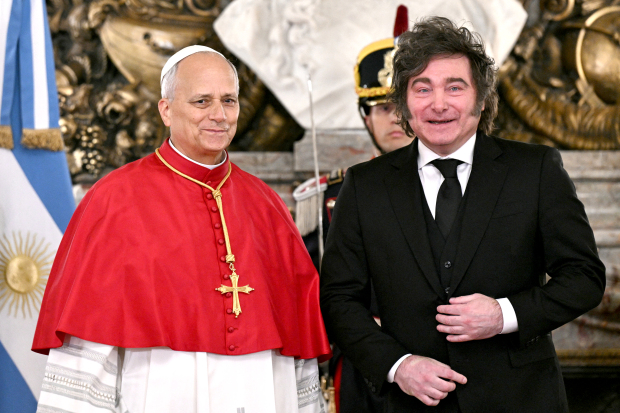
Leo was greeted at Buenos Aires’ Jorge Newbery airport under clear skies by Milei and a military band lining a red carpet as the pope descended from the plane. The president and pope shared a long, amicable handshake in a warm first public interaction.
Leo also greeted Karina Milei, the president’s sister, before accepting flowers from a group of children gathered on the tarmac.
Crowds thronged the route to downtown Buenos Aires, waving small Vatican and Argentine flags, while Catholic nuns in tan-colored religious habits chanted: “The pope is here, you can feel it.” Thousands also gathered at Plaza San Martín, the pope’s next stop.
“It’s been almost 40 years, 39 exactly, that the pope hasn’t come to Argentina,” said Claudia Sona, who travelled from the northern province of Salta. “For Catholics, and I think for non-Catholics, this is a rebirth.”
The 71-year-old pontiff, who is making one of the most intense foreign trips by a Catholic leader in decades, less than a month after undergoing lung cancer surgery.
is the first pope to visit Argentina since John Paul II in 1987 and will tour four cities through Wednesday.
Leo, on his three-country tour running through November 17, at his final public event in Uruguay earlier on Sunday urged political leaders there to work to benefit the whole country, not a select few.
Milei swept to power in 2023 after a run of center-left Peronist rule, campaigning with a chainsaw as a symbol of the deep cuts to state spending he pledged to make to shore up the country’s finances.
Leo, who addresses national governments on each of his foreign visits, usually speaks in careful, diplomatic language, but has emerged as a more forceful voice on the world stage recently, decrying the direction of global leadership.
He is not expected to directly criticise Milei by name but may refer to national policies or international events in remarks that will be carefully parsed by political observers.
“Any interventions by Leo, particularly on poverty, the limits of markets or confrontational political rhetoric, could be read as implicit criticism of Milei and amplify existing opposition to the government’s approach,” said Nicolas Watson, a managing director at advisory firm Teneo.
Milei has defended his austerity as the only way to bring inflation under control. Under his economic campaign, annual inflation has fallen from over 200 per cent to 33pc.
But surveys show his popularity has slipped ahead of elections next year as Argentines contend with subsidy cuts, public-sector layoffs and business closures linked to squeezed household budgets.
