

Israel is unable to form a new government following the latest elections and looks set to be heading for a prolonged political crisis.
Political observers attributed the deadlock primarily to the racism of the main Israeli parties and their insistence on marginalising and excluding the 19 seats won by Arab parties, denying them the right to participate in any government.
The observers said this racism exposed the false claims of ‘Israeli democracy’ and its professed respect for voters’ choices.
The election results showed that neither of the two blocs, led by Benjamin Netanyahu and Gadi Eisenkot, had secured the 61 seats needed for a majority in the Knesset. Netanyahu’s bloc won 53 seats, compared with 48 for Eisenkot’s bloc and 19 for the two Arab lists, the Joint List and the United List (Ra’am).
After consultations which indicated that a majority of Knesset members would recommend Eisenkot, Israeli President Isaac Herzog tasked him to try and form the government. According to the positions declared by the parties that won seats in the election, Netanyahu could count on the support of 53 MPs, while Eisenkot would have the backing of 67.
Despite neither bloc being able to form a government on its own, all Israeli parties have rejected the participation of the Arab parties, which won 19 seats. Netanyahu even sought to cast doubt on the legitimacy of their electoral successes, although official bodies confirmed the validity of the results.
Although the Arab list announced its support for Eisenkot in forming the government, he set conditions for any participation in the coalition that effectively sought to exclude the Arab parties. These included recognising Israel as a Jewish state, committing to the Israeli Declaration of Independence, imposing military, national or civilian service on all Israeli citizens without exception, and recognising Hamas as a terrorist organisation.
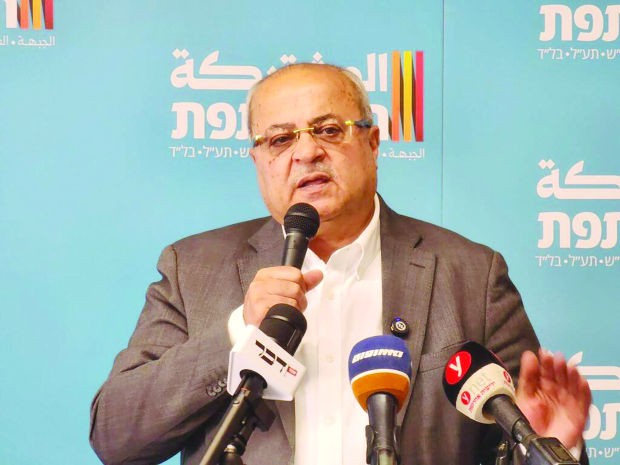
Ahmad Tibi, chairman of the Arab Movement for Change, said that no Israeli government could be formed without the participation of the Palestinians of 1948, represented by the Joint List and the United List, contrary to claims by right-wing parties.
“We cannot allow ourselves to be bypassed or 20 per cent of the population, 500,000 votes for the Joint List, to be stripped of legitimacy. They must be part of the change,” he said.
He added that the ‘four principles’ set by Eisenkot did not apply to the Arab parties, as they would not be part of the government.
“We want to be part of the change and hope. We want to improve conditions for our people and our community in areas such as violence and crime, house demolitions, infrastructure and budgets,” he added.
