

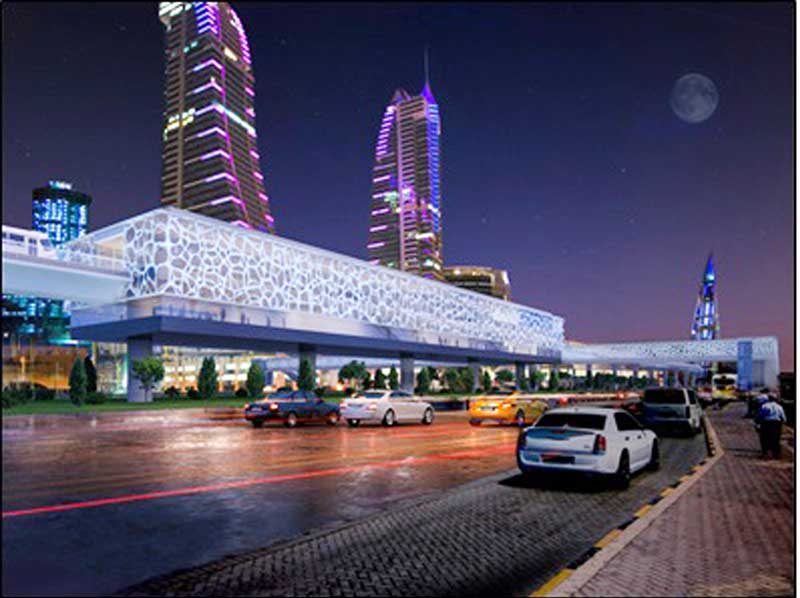
Manama: Plans for 17 train stations have been finalised as part of Bahrain’s very own rail network that will cover financial districts, residential areas and shopping centres.
The state-of-the-art platforms will be located on a 25km line that is the first phase of the Bahrain Light Rail Network, which will start at the soon-to-be constructed King Hamad Causeway and will connect to the GCC
Rail Network.
The stations will also be connected to footbridges and bus stops in several places including the Seef District, City Centre Bahrain, Bahrain Financial Harbour, Bahrain Bay and the Bahrain International Airport.
“The first phase of the designs are completed that will cover 25km of the Light Rail Network with 17 stations to be constructed,” said Transportation and Telecommunications Ministry Land Transportation Under-Secretary Mariam Jumaan.
“It will have connections at the Bahrain International Airport and the GCC Rail Station.”
Ms Jumaan was speaking during a session at the 27th Arab Engineering Conference, which ended yesterday at the Diplomat Radisson Blu Hotel Residence and Spa.
In her presentation, she said the first phase of project will have the capacity to accommodate 8,000 to 10,000 passengers.
“The Light Rail Network is an alternative to people using private cars and will help reduce congestion,” she added.
However, the entire project, which will have four rail lines covering 105km, is still in the initial stages with plans to have connections in major developments such as Diyar Al Muharraq, Amwaj Islands, Dilmunia, Nurana Island and Sehaila Island.
Other populated areas where passengers can board the monorail is Salmaniya, Umm Al Hassam, Zallaq, Riffa, Muharraq, Diplomatic Area, Juffair, Isa Town and Hamad Town.
Ms Jumaan said it was still not decided whether the railway will be underground or elevated above ground, adding that “all options were on the table”.
“No final decision is taken yet but we are looking at elevated construction with minimal land requirement and restrictions in urban areas,” she said.
The King Hamad Causeway, which is the second bridge between Bahrain and Saudi Arabia, is part of a $15.5 billion project that will also include a rail link between both nations that will be connected to the GCC project.
Saudi Ambassador to Bahrain Dr Abdulla Al Shaikh said last month that work on the project was started by the Saudis.
The 2,100km GCC network will pass through all six
Gulf states with 108 passenger trains and will cost more than $200bn.
“The feasibility study on the [King Hamad Causeway] is completed and preliminary designs will start later in the year,” added Ms Jumaan.
“We are looking at two options which is only allowing rail [track] or having both rail and road [networks].”
Ms Jumaan also said that her ministry along with their Saudi counterparts were in discussions on the first phase of the GCC rail.
“Thirty-six per cent of freight traffic and 6pc of car traffic over the [existing] causeway is expected to be shifted to the rail,” she explained.
She said plans for a frequent commuter service to Dammam and a direct service to Riyadh from Bahrain were being studied with a connection
to Bahrain International Airport.
“The connection to Bahrain’s port will be the next
phase as part of the country’s vision as a logistics hub,” she added.
“All these projects will encourage economic growth and the ministry has a clear vision of how it wants the land transport sector to develop.”
Meanwhile, World Bank GCC resident adviser Dr Ramiz Al Assar said trains operating in the GCC Rail Network would be diesel-powered and that the private sector will handle maintenance in all six states.
“The GCC Rail Network, both passenger and cargo, will integrate the six countries, promote economic growth and generate employment,” he said in his keynote address.
sandy@gdn.com.bh
&uuid=(email))