

PLANS to strengthen Bahrain’s fisheries sector in partnership with the private sector, to achieve food security and self-sufficiency, is on track.
Nearly 70 per cent of the land allocated in Ras Hayyan for dedicated fish farming projects is ready in preparation for inviting investors to launch commercial production, according to Works, Municipalities Affairs and Urban Planning Minister Essam Khalaf.
This will contribute to reducing pressure on existing fisheries and bringing down the cost of fish in the market, he added.
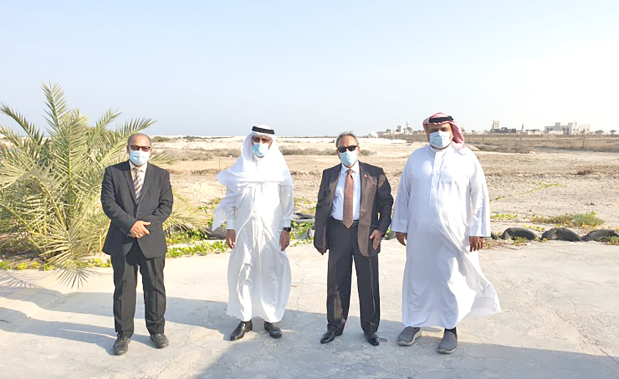
The minister made his remarks as he, accompanied by the agriculture and marine resources director Under-Secretary Dr Nabil Abu Al Fateh and roads maintenance department director Badr Al Alawi, visited the site to assess the progress of the project.
He underlined the importance of taking advantage of the areas designated for cultivation in the Ghamis region, southeast of Bahrain, following the summer, to provide an opportunity to reduce costs for investors and give environmental space to support fish growth faster in their natural environment.
“The ministry is continuing its efforts to enhance partnership with the private sector in the field of fish farming, in an effort to raise the production capacity of the National Centre for Marine Aquaculture in the Ras Hayyan area,” said Mr Khalaf.
“This step is a continuation of the success achieved by the qualification and training programme for a number of Bahraini cadres in fish farming that the ministry has established in co-operation with the Tamkeen Labour Fund, which aimed to train 15 Bahrainis in the field of local fish farming inside and outside Bahrain.
“The fish farming sector constitutes an important axis within the ministry’s strategy, which comes in support of the government’s directives to achieve food security in Bahrain, especially as the fisheries sector is an important pillar within the food sources of citizens and residents in the kingdom.”
Mr Khalaf also stressed that efforts will continue, to attract more private sector companies to launch investment projects that will maximise local fish production in order to achieve self-sufficiency.
Dr Abu Al Fateh emphasised the inclusion of the private sector as a main partner in fish farming projects and the provision of lands to contribute to the growth and development of Bahrain’s food economy.
“One of the most important tasks we are working on is to introduce professional and highly qualified personnel who contribute to the development of the fish farming sector,” he said.
“The directorate has made important strides in the field of feed-related research, which also contributes to the growth and development of fish farming.”
The GDN previously reported that His Majesty King Hamad gave instructions to set up a government-owned company for each type within the project, covering agriculture and fish farming.
The strategy aims to develop national food industrial capabilities, increase local production and preserve agricultural professions.
Six plots of land have been identified across Bahrain to be used to boost agricultural production as part of efforts to ensure food security.
The plan also seeks to bolster fish farming with four sites earmarked for the purpose.
The move is expected to raise the local production of vegetables up to 20 per cent and also achieve 50pc to 62pc self-sufficiency in fish.
ghazi@gdn.com.bh
&uuid=(email))