

A total of 58,000 heads of livestock have been imported into Bahrain in preparation for Eid Al Adha.
This is in addition to 5,600 tonnes of frozen meat brought into the kingdom to cover the demand during the religious event in the coming few days.
Procedures
According to Animal Resources Under-Secretary Dr Khalid Ahmed, all preparations have been completed to commemorate Eid Al Adha which starts on Tuesday.
“We have undertaken all procedures required to prepare for the blessed Eid Al Adha which includes facilitating the issuing of licences to import live animals, in addition to fresh, chilled and frozen meat,” he said in an official statement.
“Livestock traders had already started their preparations for the Eid Al Adha season from June as they imported 58,000 heads of livestock. They have also imported 3,600 tonnes of poultry and 2,000 tonnes of chilled and fresh meat.”
Dr Ahmed reaffirmed that he believes the quantity available in the market is enough to accommodate local needs for Eid Al Adha.
He also revealed that there has been an increasing demand for meat – either for sacrifices or for Eid Al Adha lunches.
“It is critical to only deal with licensed abattoirs and refrain from dealing with random slaughterhouses which could be a big threat to public health,” he added. “These random and illegal abattoirs also have a negative impact on the environment and all citizens and residents are advised to only deal with licensed places.
“There are only two licensed slaughterhouses and one is in Hamala while the other is in Sitra. They are fully equipped with all the required health and safety precautions, in addition to a veterinary doctor who oversees the slaughters.
“The vet also examines the livestock following the slaughter to ensure that they are free of diseases.”
He highlighted that the extraordinary circumstances across the globe imposed by the Covid-19 pandemic require complete co-operation from all parties involved.
He also stressed the importance of adhering to all health and safety precautionary measures that have been issued by the National Taskforce for Combating the Coronavirus.
Meanwhile, livestock trader Ali Hassan told the GDN that the importing process was facilitated with ease for traders by the government.
“Prior to Ramadan I had imported around 9,000 heads of livestock from Somalia and I’m now awaiting an additional shipment of 5,000 more for Eid Al Adha,” he said. “The government has spared no efforts to ensure a smooth importing process and fully-supplied market as the only problem we face is the duration of the trip that the livestock undergo at sea.
“They spend around nine to 10 days at sea and they sometimes arrive here a little dehydrated. Besides that, the process is incredibly easy and we are able to cover the demand in the market.”
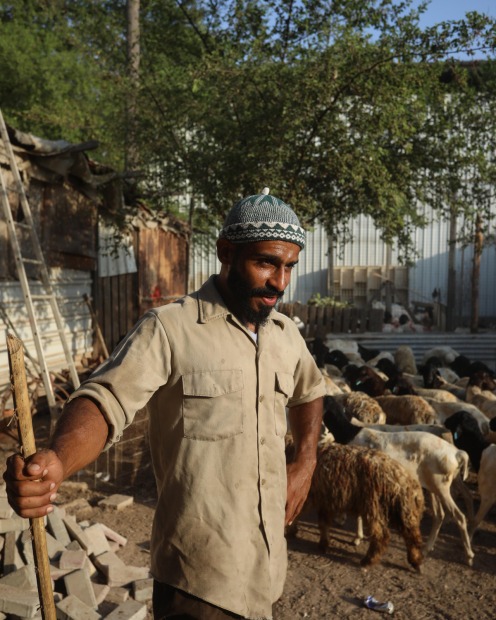
Ali Al Qassab with his stock
Meanwhile, livestock trader Ali Al Qassab told the GDN that he expects a rush of demand the day before Eid but at present the market is steady.
“I buy and sell around 500 heads of livestock,” he added. “We offer people two services and the first is just reserving the sheep for them which gets branded with blue paint and costs BD55. We also offer the sheep and its slaughter for BD60 and these get branded with red paint until it’s time.
“The process is very smooth and facilitated in Bahrain for us as traders and the most critical point is adhering to precautionary measures and building good relationships with people.”
reem@gdn.com.bh
&uuid=(email))