

BAHRAIN registered a 25 per cent reduction in carbon footprint last year compared with the previous year, thanks to the coronavirus (Covid-19) pandemic, according to a research paper.
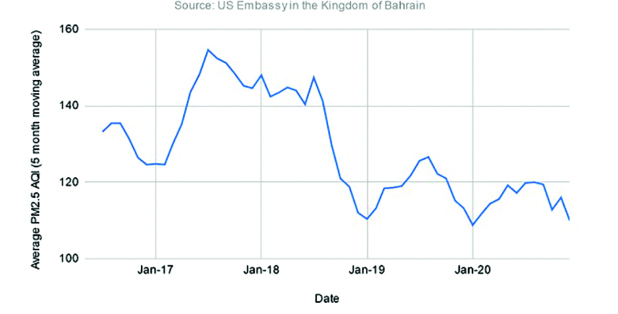
The study, ‘Covid-19 Environmental Impact in the Kingdom of Bahrain’, also indicated that there was a “slight” improvement in the country’s air quality – by 4pc.
Four researchers who worked on the report agreed that the significant reduction in land and air transport caused by the lockdowns and social distancing measures led to a diminished carbon footprint – the amount of carbon dioxide released into the atmosphere as a result of human activities.
Bahrain recorded ‘slight’ improvement in air quality
“This decrease would have been significantly reinforced by the absence of the approximately 10 million tourists that Bahrain welcomes from Saudi Arabia annually via the King Fahad Causeway,” said the paper published by the Bahrain Centre for Strategic, International and Energy Studies (Derasat) in partnership with the UN Development Programme.
The research was based on interviews with 14 environmental experts from the private and public sectors as well as academics and staff from non-profit organisations, who affirmed that the findings were “limited” due to the absence of reliable official data.
“The Bahrain Airport Company (BAC) indicated a 25pc reduction in its 2020 carbon footprint compared with 2019, excluding emissions from electricity as these were temporarily higher due to the need to operate two terminals during the transition from the old airport to the new one.
“The reduction in carbon was equal to approximately 380 tonnes of CO2, and reflected diminished emissions from vehicles, generators, refrigerant top-up, and so on.
“However, the experts also indicated that decreased transport-related carbon emissions were partially offset by increases in other sectors.”
On the pandemic’s impact on air quality, the report cited “third party data” (US Embassy) due to significant measurement challenges and technical problems at the government’s air quality stations.
“The data shown indicate that during 2020, there was a slight decrease in particulate matter (PM – a mixture of solid particles and liquid droplets found in the air) compared with 2019, which was equal to 4pc when year-on-year averages are calculated,” said the report.
However, the study noted that this data was from only one location – which happens to be next to a major highway away from the central business district – and hence “unclear how representative its observations are of the entire country”.
Aircraft movements declined by 58pc during 2020 compared with 2019, while total passengers decreased by 76pc.
“It is expected that this decline had a positive impact on air quality in the airport’s vicinity – the US Embassy’s station is approximately 14km away from the airport.
“The available data indicate a slight improvement in air quality, likely driven by decreased air and ground transportation, but data coverage falls significantly short of what is required for a definitive assessment.”
Meanwhile, the study also hinted a relative increase in medical and non-medical waste related to personal protection equipment and single-use materials. This has raised concerns regarding the long-term impact on biodiversity, and in turn on human health.
Derasat Studies and Research, and Economics and Energy Studies director Dr Omar Al Ubaydli, one of the four researchers, told the GDN that the issue of environmental impact of the pandemic was “complex” and could not be addressed through a research.

Dr Al Ubaidly
“The impact of Covid-19 on the environment is complex and cannot be summarised in a research. In reality changes vary – some are temporary, while some others are permanent – so it’s complex.
“The sustainable positive impact on Bahrain’s environment with people switching to remote work is a good aspect, while the amount of plastic waste added to the environment is a negative aspect.
“With people using masks, one family generates at least two a day that are thrown; where do they end up?
“In the long run this could develop into a crisis and we believe that public should be encouraged with incentives to come up with innovative solutions to address this.
“We need young Bahraini minds to brainstorm and come up with fresh ideas on how to decrease this waste.”
Dr Al Ubaidly cited the need for Bahrain’s waste management system to be updated in the context of Covid-19, noting the waste was now bio-hazardous. He added that Covid-19 has redefined the equations of renewable energy.
The other researchers who worked on the paper were Ghada Abdulla, Abdulaziz Al Doseri and Deema Al Moayyed.
raji@gdn.com.bh
&uuid=(email))