

STORIES passed down through generations of Bahraini families with pearl-diving heritage have become key to the archaeological excavation work being conducted at the Pearling Path in Muharraq.
An inscribed stone, found in the Jalahma House just last week, confirmed the existence of and history behind an artesian well in the area, which thus far has vividly featured in stories from pearl-divers during the early 20th century.
Professor Robert Carter from the British archaeological mission revealed this find, along with other discoveries in Muharraq, during the fourth of a series of virtual lectures being hosted by the Bahrain Authority for Culture and Antiquities (Baca).
The Arabic inscription on the stone starts off with a verse from the Holy Quran’s 76th chapter (Surah Al-Insan), verses 17 and 18, and then adds: “Dug by Ali bin Saqer for the divine reward of the late Shaheen bin Saqer. Work started on it on the 18th day of Ramadan, and he made it to provide water for people. It was done in the Islamic year 1344, April 1, 1926.”
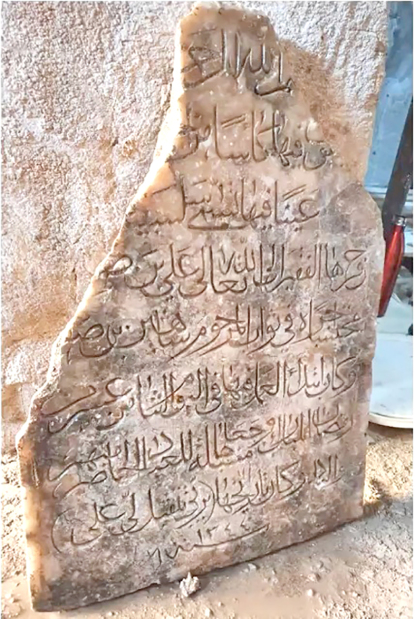
The recently-discovered inscribed stone
The inscription, found at the old family home of the Jalahma brothers, who were major pearl merchants in the 1920s, confirms the timing of the well being dug.
It also asserts that the well was done as part of philanthropic work undertaken by Ali bin Saqer Al Jalahma when his brother Shaheen died.
“This archaeological find, which will be on display soon, confirms a key element of many oral histories that we have been collecting from the families in Muharraq, almost every one of which have a link to Bahrain’s pearl-diving trade,” Prof Carter noted.
This inscription is the latest in a series of documents which colour in the details of Bahrain’s pearling history, which is being preserved at the Pearling Path – a Unesco-certified heritage site.
The Pearling Path covers historical and archaeological sites, dwellings of divers, merchants and others involved in the trail, a music house, pearl beds, as well as exhibitions and information displays.
The documents preserved include deed documents, merchant letters, and ledgers, which paint a picture of a resilient pearling industry that resisted the scourge of cultured pearls, when they first appeared in 1921.
An interesting document in the archive is a decree from the British Government in 1912, banning modern diving equipment, like diving helmets and underwater rakes.
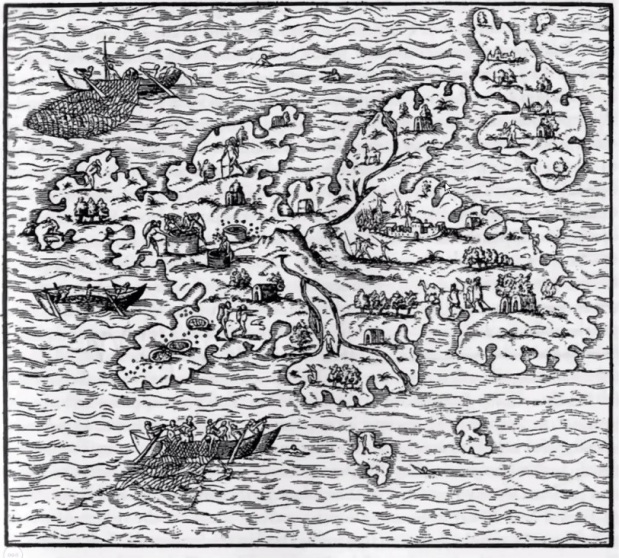
A pearl fishing map from 1575, showing Muharraq and nearby oyster beds
Equipment
“A few merchants at the time, as well as foreign speculators, wanted to introduce modern diving equipment, which caused a lot of debate and argument,” Prof Carter explained. “The local pearl divers were mostly against it, since they believed it would cause an imbalance between those who could afford this equipment and those who could not.
“As a result, we saw a ‘fossilisation’ or preservation of traditional pearling techniques, which incidentally worked very well for Bahrain. Despite being the largest pearl fishery in the world, with the greatest number of people working on it, it never ran out of pearls.
“To compare, South American pearl hunters destroyed their oyster beds by using dredges, and these beds did not return for centuries. This kind of equipment was banned in Bahrain.”
The excavations taking place along the Pearling Path have also revealed pottery from early Islamic era (7th century AD) onwards at every site, as well as evidence of the expanding shoreline, as a result of ongoing land reclamation work.
The discoveries paint a picture of an era of Bahrain, when it single-handedly produced nearly 40 per cent of the global supply of pearls. According to data compiled by Prof Carter about pearl exports between 1770 and 1940, Bahrain’s pearling industry saw its golden era between 1880 and 1920, with exports nearly quadrupling during this time.
The introduction of cultured pearls globally, as well as a number of tragic sea accidents involving pearling fleets, saw the industry quickly decline after this. However, to this day, Bahrain remains the only country that has banned the trade of cultured pearls.
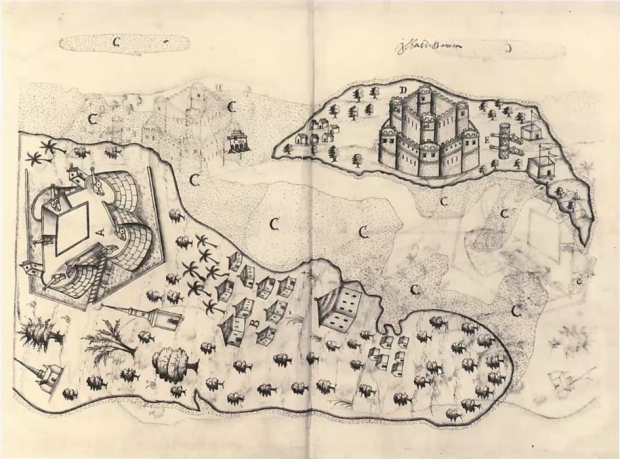
A Portuguese map of Bahrain and Muharraq, circa 1580.
The Pearling Path’s history goes far beyond that with maps available from as early as 1580, charting the island of Muharraq, as well as pearls from as early as the 16th century BC.
Prof Carter’s talk was the fourth in a series of six virtual lectures, the next of which takes place on September 22.
The next lecture will be conducted by Mustafa Salman in Arabic and will focus on the archaeological discoveries at Abdulla Juma’s farm in Maqabah.
The final lecture in the series will take place on September 29, with Dr Masashi Abe of the Japanese archaeological mission, talking about the excavation work undertaken in Wadi Al Sail.
naman@gulfweekly.com
&uuid=(email))