

PEOPLE feeding stray dogs in residential areas and freeing them from cages could face hefty fines in the Northern Governorate, councillors warned yesterday.
Allocating specific locations for feeding stations away from homes and neighbourhoods could temporarily ease the tension as the government commences with a shelter plan.
Animal activists have been urged to support the initiative rather than working against the authorities.
Northern Municipal Council members yesterday once again called for tougher action on the dog food spreaders, as council chairman Ahmed Al Kooheji demanded strict implementation of the 2019 National Cleanliness Law.
“People who leave food for stray animals in residential areas must be fined along with those who free captured dogs from cages,” said Mr Al Kooheji during a meeting held yesterday with representatives from the Interior Ministry, catch, neuter and release operators Black Gold Company, councillors and animal protection societies.
Works, Municipalities Affairs and Urban Planning Ministry’s Agriculture and Marine Resources vet clinics and disease control department chief Dr Abbas Al Hayki stressed the importance of joint meetings with authorities concerned to collaborate efforts and achieve the proposed strategy through community partnership.
He added that Black Gold has been contracted by the ministry starting March 1 this year with the contract ending on December 31, 2022.
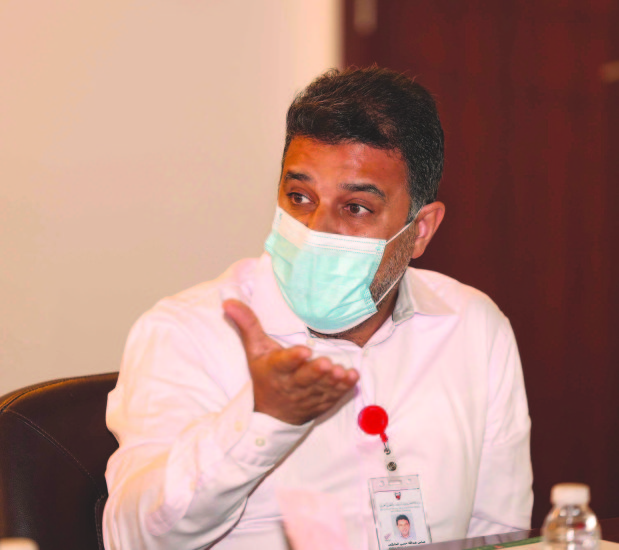
Dr Al Hayki
“We have a two-prong approach in terms of achieving our strategy to eradicate the stray dog problem in Bahrain,” Dr Al Hayki told councillors.
“The current phase is catching the dogs from residential areas then neutering, followed by releasing them in non-residential areas.
“I agree this isn’t a permanent solution but a temporary one until the long-term strategy of a pet park is created.”
Technical Committee chairman Abdulla Al Qubaisi suggested offering citizens and residents BD1 per dog they catch and hand over to the authorities.
“We were contracted to do a specific job yet we are carrying out initiatives that weren’t part of the agreement on our own,” said Black Gold operations manager Ali Ebrahim.
“Our system was installed to answer complaints and capture those dogs but when we see a dog that wasn’t complained about we capture those too.
“We need animal activists to co-operate with us and not act against us by feeding the animals or breaking them out of their cages.”
Dr Al Hayki previously revealed that 3,750 strays were caught from December 2017 to August 2021, and a total of 2,138 dogs were also neutered between January 2019 and August this year.
Cat Society of Bahrain and Pet Animals president Hana Kanoo highlighted that collaborative efforts were critical to ensure a humanitarian long-term solution.
She revealed that the society held its first Press conference regarding stray dogs in 2004 after sensing a possible growing problem in Bahrain.
“We know that it is a violation of the law to feed animals in residential areas and a solution for this could be licensing people for specific feeding stations away from residential areas,” said the society’s vice-president Mohammed Al Mass.
“Tranquilisers can be placed in guns and the Interior Ministry can aid in the capture of the dogs in a humanitarian way.
“Creating specific feeding stations in each governorate away from residential areas is the ideal solution to remove them from neighbourhoods while also easing their capture.”
The council yesterday approved recommendations to allocate several plots of land for the creation of legal shelters, to fine people for feeding and breaking dogs out of cages, and for an urgent meeting with Works, Municipalities Affairs and Urban Planning Minister Essam Khalaf with the animal activist societies in order to collaborate officially.
The GDN previously reported that a BD400,000 shelter has been planned for Hafeera in the Southern Governorate, covering an area of 40,000sqm, will feature green areas and buildings with an estimated 15,000sqm set aside to accommodate around 5,000 dogs.
reem@gdn.com.bh
&uuid=(email))