

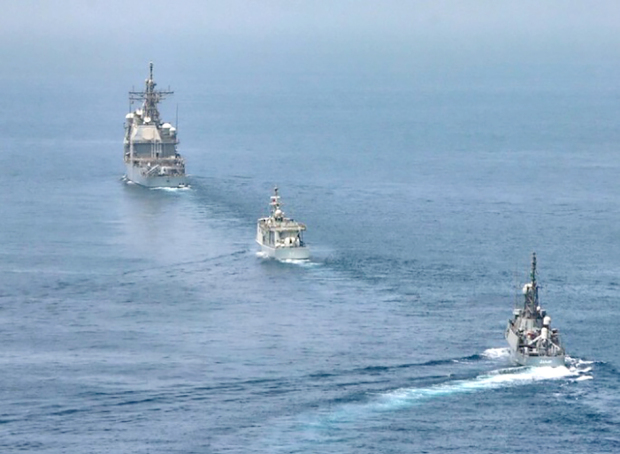
A THREE-PRONGED strategy driven by technology will be the way forward in addressing regional maritime threats, said a top naval officer.
Military autonomy, civilian autonomy and cyberspace will be the three domains that will emerge imperative in the near future, according to Bahrain-based International Maritime Security Construct (IMSC) Commander, Commodore Gordon Ruddock.
The British Royal Navy officer also believes there is a need for a new international maritime legal framework to address ‘lean-crewed’ vessels at sea, while speaking exclusively to the GDN at the Mina Salman Naval base, alongside Royal Bahrain Naval Forces (RBNF) Flotilla Commander Commodore Yousif Ahmed Al Mannaie and IMSC Deputy Commander US Navy Captain Alan Baca.
“It will enhance our ability to see what the next challenges are going to be,” said Cmd Ruddock. “Technology has evolved to a state now where computers have significant analytical capability.”
There is work going on the background and naval commanders believe it is important that systems that enable at least partial automation should be integrated.
Many observers believe that transitioning towards a highly-autonomous concept can provide improved operational capabilities while retaining asset flexibility by keeping a limited number of highly-skilled personnel on board.
With the danger of hypersonic missiles and other new threats on the horizon, a computer can pick out and track those things better than a human can, they suggest.
Removing personnel from direct line of fire is another important aspect. It could improve the quality of life of servicemen and increase navy retention rates because crew members could do some of the roles onshore rather than having to necessarily always be on the vessel.
“The military autonomy is a force multiplier, meaning, it’s greater than the sum of its parts,” added Cmd Ruddock. “It allows over-watch and intelligence gathering with its presence, posture and profile to happen in the background without much human interaction and intervention.
“It would enhance our ability to see what the next challenge is going to be because technology has evolved to a state now where computers have significant analytical capability.”
He pointed out the recently set up Task Force 59, as highlighted earlier in the GDN, was aimed at looking at ways in which military autonomous vehicles and systems could be employed in the region.
“There are challenges,” he admitted, “whether concerning the climate, density of traffic or legal frameworks.”
The GDN reported last month that the RBNF will partner with Task Force 59 – a first-of its-kind US Navy Task Force focusing on the integration of unmanned systems and AI, under the US Fifth Fleet, to tackle emerging threats.
Taking aside military aspirations, civilian autonomous systems are already in play, with testing continuing apace.
With naval forces in place, headquartered in Bahrain, to ensure safe marine travel, this poses additional challenges too. “We already see, in various experimental areas, very lean-crewed vessels and even some vessels which have no crew,” said Cmd Ruddock.
“We really need to have a discussion about how that technology is going to come into play in the broadest possible sense, but then in the military, as to how we, as maritime security experts, will deal with them – particularly, if there is a threat to the security of a very lean-crewed vessel.”
And, cyberspace will offer a crunch challenge all of its own with on-shore computer systems already giving orders, directions and maintenance instructions to vessels.
The fear is what will happen if the ‘bad guys’ are able to hack or carry out a cyberattack on one of those vessels travelling in a sensitive area.
“Routing orders communicated from shore could be intercepted by actors who wish that vessel – or the free flow of commerce – unwell,” explained Cmd Ruddock. “So reinforcing cyberspace defences and our understanding of what the interdependencies of cyberspace are going to be, are really important going forward.”
Cmd Al Mannaie acknowledged that the ‘fast pace of technology’ was adding yet another challenge to the maritime domain and the waters covered by the Bahrain Defence Force and its partners.
“We are aware of it and working hard to offer up-to-date solutions to ensure the security of our sea and region,” he reassured.
Cpt Baca stressed that technology was already a huge enabler for the IMSC mission – to help reassure merchant vessels that they are to continue operating in safety.
“Technology enables us to have such a larger presence in the area because we can have our eyes in so many different places. The more situational awareness we can have, the greater our ability to deter those bad actors.”
raji@gdn.com.bh
&uuid=(email))