

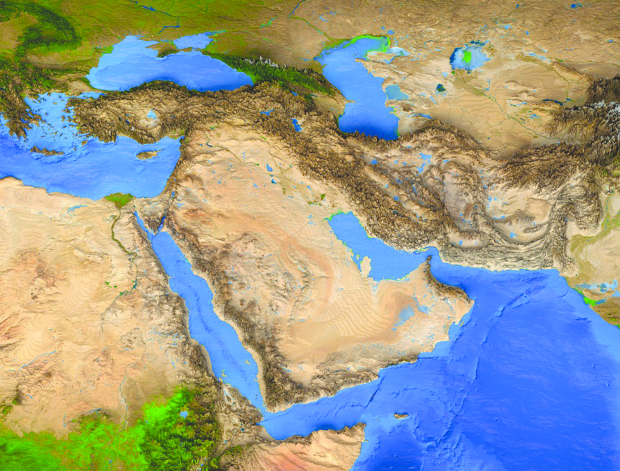
WINTERS in the GCC could be drier, with more flash floods, while summers could see soil erosion as climate change worsens the nations’ ecosystems, according to experts.
Panellists at the 14th Gulf Water Conference predicted an average temperature increase of 0.8C in the GCC during the winter season (November-April) over the next 20 years (2021-2040) compared with over a decade ago (1995-2014).
The three-day forum, which concluded in Riyadh on Tuesday under the theme ‘Water in the GCC: Towards Economic Efficiency and Financial Sustainability’, was organised by the Bahrain-based non-governmental organisation Water Sciences and Technology Association and hosted by Saudi Environment, Water and Agriculture Minister Abdulrahman bin Abdulmohsen Al Fadley.
Economic and Social Commission for Western Asia (UN-ESCWA) Climate Change Data and Geospatial analyst Marlene Tomaszkiewicz highlighted the challenges the Arab region faces in ensuring sustainable water management and services amidst its diverse and complex geopolitical and socioeconomic landscape.
“Climate change is expected to exacerbate system pressures, raising concerns about food security, energy resources, human health, and ecosystems,” she said.
“Climate models are effective tools for quantifying the magnitude of change.
“Programmes like Regional Initiative for the Assessment of Climate Change Impacts on Water Resources and Socioeconomic Vulnerability in the Arab Region (RICCAR) help bridge the gap between climate science and effective policy-making.”
RICCAR – the result of the first Arab Ministerial Declaration on Climate Change issued in 2007 – identified the potential effects of climate change in the Arab world.
It called for a comprehensive assessment of such impacts on the most vulnerable developing countries, including the GCC, as well as the identification of priorities and the implementation of national and regional climate change adaptation and mitigation programmes.
“Within the next 20 years (2021-2040), RICCAR studies indicate an average temperature increase of 0.8C in the GCC during the winter season (November-April) compared to just over a decade ago (1995-2014),” said Ms Tomaszkiewicz.
“By mid-century (2041-2060), the projected increase is 1.9C.
“During the summer (May-October), the rise in temperature is expected to be slightly higher; in the GCC, projected changes are 0.9C and 1.9C by near-term (2021-2040) and mid-term (2041-2060), respectively.
“With regard to precipitation, although the volume is projected to increase slightly, spatio-temporal variability will exacerbate.
“Rather than alleviate water scarcity, such irregularity will induce floods as well as droughts.
“Climate science and resultant modelling outputs are not necessarily cause for alarm.
“Bridging the science-policy interface is rather a call for effective action.”
Four other experts spoke on the impact of climate change on water resources in the GCC, the session was moderated by Arabian Gulf University water resource management professor Dr Waleed Al Zubari.
UN Food and Agricultural Organisation Economic Analyst of the Impact of Climate Change on Agriculture in Arid Regions Dr Walid Saleh noted the “complexity” and the unpredictable aspects of climate change as the “most challenging environmental problem”.
“The consequences of climate change are therefore diverse, while populations in low-income countries are increasingly exposed to its negative effects.
“While food security can be enhanced by increasing agricultural production, it is affected under unsustainable circumstances such as water scarcity.”
He warned of the threat of climate change on food security, hinting at the lack of information on the impact of increasing water scarcity on the economies, employment, and food security of the region.
“Water scarcity could lead to land-use change and deforestation.
“Agriculture will suffer because of climate change and water scarcity, and crop prices are expected to increase for both crop producers and consumers.
“According to RICCAR, additional information related to variations in extreme weather indices was also considered for a better understanding of the impacts of climate change on water supply in the region until the period 2030-2050.
“The results envisaged drier winters and increased incidence of flash floods and surface run-off during the summer.”
Changes
Others on the panel were Mansour Almazroui from the King Abdulaziz University, Jeddah; Cyprus Institute Energy, Environment and Water Research Centre director Fadi Georges Comair; and Morocco Mohammed V University’s Regional Water Centre of Maghreb expert Abdelkader Larabi.
Mr Almazroui highlighted the possible changes to water resources in the context while Mr Comair used a Cyprus study to elaborate on the environmental coastal co-operation for eco-sustainable development.
Mr Larabi expounded the climate change impact on groundwater using simulation modelling.
raji@gdn.com.bh
&uuid=(email))