

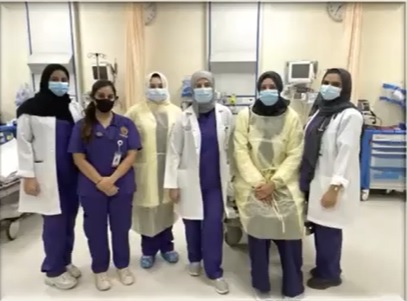
ONLY 36 per cent of the country’s emergency physicians are women, mirroring the global gender disparity in the speciality.
Two of the 13 certified emergency medicine (EM) consultants are females, while one of the three medics heading emergency departments at Bahrain’s three public hospitals is a woman.
The statistics were revealed by Bahrain Medical Society president Dr Ghada Al Qassim, who stressed the need for more women physicians in the kingdom, especially in the field of emergency medicine (EM).
She also called for innovative ways to recruit and retain women in EM, the failure of which ‘will be denying the added value that women could render to the sensitive speciality’.
“Our workforce needs more women physicians, especially in EM,” she said.
“Women are vital as the ideas, skills, interest and creativity they bring are essential for the success of the speciality,” said Dr Al Qassim, in her keynote address at the second Bahrain Emergency Medicine Conference (BEMC) 2021 yesterday.
“There are 144 EM physicians in Bahrain at the three emergency departments – the BDF Hospital, the King Hamad University Hospital and Salmaniya Medical Complex,” she noted.
“Of this only 52 are women (36pc).
“There are 13 certified consultants in the country of which 11 are men (84.6pc).
“Of the three emergency departments, two are chaired by men.”
Dr Al Qassim, a paediatric emergency consultant and BDF Hospital emergency department head, highlighted the gender discrepancy in emergency medicine globally.
“Although females comprise 50pc of medical school classes, they make up only 25pc of EM-trained physicians,” she said.
“And even smaller percentage of women are in major leadership positions within EM.
“Emergency medicine must attract and retain women physicians, while concurrently addressing their unique needs so that they can provide medical care for the millions of patients who annually visit the nation’s emergency departments.
“As our nation adapts to meet unprecedented challenges in healthcare, teams should include more women physicians.”
Dr Al Qassim highlighted the challenges for women in EM – the shift-based routine, the physical exhaustion, emotional stress and the male dominance in the speciality.
She called for more women-friendly policies including maternity leave and lactation facilities for doctor mums at hospitals.
“There should be female involvement in recruitment and whenever possible, women should be paired with female mentors, at least during their first year,” she said.
“We must make it a point to highlight progress made by women physicians at workplace and recognise and promote the added value women bring to the department.”
She also sought more flexibility in physicians’ schedules and part-time options to encourage women.
“It’s vital to provide clean private non-bathroom facilities for lactation within or adjacent to the emergency department,” she said.
In her presentation, Dr Al Qassim highlighted a report by the US-based Accreditation Council for Graduate Medical Education in 2013-2014, which found that of the total 5,743 emergency residents, only 2,077 (36pc) were women.
The 16-member Association of American Medical College had two women on board and of the 42 committees, only 11 were chaired by women.
“These statistics reveal that the number of women leaders in emergency medicine are few in number,” she said, calling on more people to break the glass ceiling.
“Women leaders can improve recruitment and retention of women in EM.”
raji@gdn.com.bh
&uuid=(email))