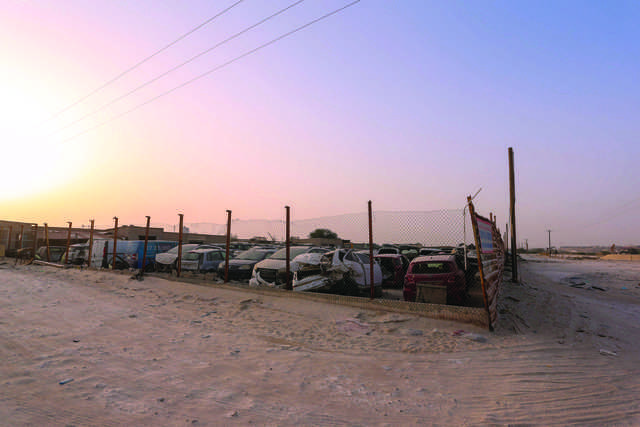
ONE hundred sprawling scrapyards in Askar, sitting on crude oil worth multi-millions of dollars, could be relocated faster than a given 12-month ultimatum, in a bid to fast-track excavations and allow the country to benefit from an unprecedented rise in the value of the commodity.
The GDN reported in February 2018 that Tatweer Petroleum has told former Southern Municipal Council members that between three and four million barrels of oil worth at the time more than $175 million, had been located onshore, near Askar.
The figure is probably now a conservative $350 million. Since then the price of a barrel of oil has sky-rocketed to more than $100, which is double from the $50 market calculation at the time.
In August last year, scrapyards were given time to relocate by the Southern Municipal Council to a nearby site in Hafeera and clear the place they are occupying.
It appears little movement has taken place despite 21 fire engines and 85 firemen being deployed to tackle a large blaze that ripped through a scrapyard in Askar in July last year.
Flames engulfed scrap vehicles and plastic waste, also igniting wooden cabins and other debris.
“Excavation takes time and the faster those scrapyards are removed, the faster work can commence,” Parliament’s services committee chairman Ahmed Al Ansari, who is the council’s former chairman told the GDN.
“I have proposed that councillors clear up the area within a month and relocate them to the new site earmarked so Tatweer Petroleum can step in.
“Oil prices have reached an unprecedented height and although they have dropped from a high of $120 per barrel last month, the country can still make huge profits from the current rates,” he added.
The council has previously campaigned against the scrapyards over safety and security concerns, claiming they stored volatile substances that could explode if not handled properly.
In September 2016, it was also claimed at council meetings some were being used by ‘mafias’ as cover for dealings in illegal weapons, drugs, stolen cars and hazardous chemicals, with the area witnessing major fires that sometimes took up to a day to extinguish.
Mr Al Ansari, who is also Al Asala (Salfi) Parliamentary Bloc president, claims scrapyards pose an environmental and health hazard besides a threat to security. “Multiple fires and crimes have occurred on those sites over the years because warehouses have been built for flammable substances, used as a hideout for fugitives, and even places to breed cattle,” he said.
He has been backed by current council chairman and area councillor Bader Al Tamimi, who suggested that the interest of the country in getting the oil reserves is more important now than ever.
“Scrapyard owners can relocate within a month with assistance from the relevant authorities and modern technologies have made moving much easier than what it used to be a few years ago,” said Mr Al Tamimi.
“Bahrain is in need of every fils to meet its financial commitments and tackle the deficit it is currently in.”
Scrapyards have existed on land near Alba for around three decades.
Their owners have over the years denied the claims against their businesses as unsubstantiated, have refused relocation, claiming there was limited space and unsuitable infrastructure at the suggested new location, while pointing out they had long-term leases for the sites they currently occupy.
Hazard
Scrapyard owners told the council last month that the new proposed location was smaller, adding that land contracts were ‘valid’ with the Southern Municipality, and they preferred to stay put. “The new site proposal should be an upgrade to the existing yards and not something lower,” they said in a joint statement.
However, they have only five months notice before they are forced to leave … unless an earlier date can be agreed.
It comes as the municipality removed 60 tonnes of ‘heavy substances’ including 30 dumped machines last month that it claimed violated road occupancy rules.
The area was originally chosen for its remoteness, but fast encroaching urban development, including Riffa Views, Bahrain’s first residential golf and leisure community, has spurred fears that the yards now pose potential health and safety risks.
They were previously earmarked for relocation after an arson attack in 2010 left several badly damaged.
“It is in everyone’s interest that the scrapyards move because they are potential hazards to those around them – whether homes, industries or labour accommodation,” added Mr Al Tamimi.
The Askar oil discovery should not to be confused with last year’s announcement that up to 80 billion barrels of shale oil had been discovered off Bahrain’s west coast.
Many economists view crude oil as the single most important commodity in the world as it is currently the primary source of energy production.
Oil prices have moved again in recent days, as a large increase in US crude inventories failed to soothe worries about tight global supply, with major oil traders expected to shun Russian barrels following its conflict with Ukraine.
mohammed@gdn.com.bh