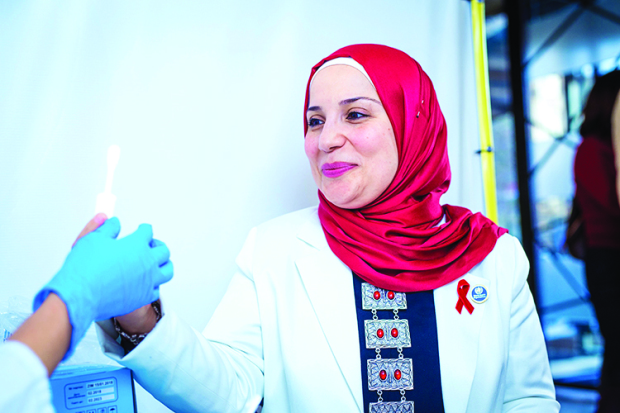
BAHRAIN’S ‘real-time’ data from its Covid-19 ‘war room’ led the country to its success story with tackling the pandemic, said a global report.
The WHO 2020-21 End of Biennium Reports on Bahrain on Tuesday noted that the data-driven approach placed the country on its international ‘health emergency network’, supported by the WHO country office headed by Dr Tasnim Atatrah.
“Guided by WHO’s strategic priority to ensure one billion more people are better protected from health emergencies, the country office hosted a joint mission, including representatives from the three levels of WHO, to document Covid-19 success stories,” said the report.
“Close collaboration with the Health Ministry, Supreme Council for Health and Office of the Prime Minister (on coronavirus) enabled access to key operational areas in hospitals, polymerase chain reaction (PCR) testing facilities, vaccination centres, and the ‘war room’ (the Covid-19 administrative hub).
“The war room produced real-time data dashboards which the government used for strategic decision-making.
“Results included bringing the country office into the WHO global health emergencies network and building the foundation for a platform for best practice exchange in health emergencies.”
The office, in a span of 10 months, also created a smart action plan to help reduce tobacco use prevalence, came up with recommendations to better tackle non-communicable diseases (NCDs), trained staff on dealing with school mental health issues, developed the Bahraini Dietary Guidelines and helped the country become the first in the region to design a national action plan to improve access to assistive health technology.
WHO Director General Dr Tedros Adhanom Ghebreyesus opened the country office on July 26, last year, located in the Health Ministry’s complex in Sanabis. Dr Atatrah, appointed on June 1 last year, heads the 20th country office in the Eastern Mediterranean region and 152nd global office.
“Creation of the new WHO country office in Bahrain has cemented results-oriented work on the ground through strengthened partnerships and regional collaboration, even in the midst of the Covid-19 pandemic,” said Dr Atatrah.
A virtual mission with the Health Ministry and the WHO EMRO discussed strengthening tobacco control efforts in the region to achieve WHO triple billion and SDG targets.
“With inputs from WHO, the Bahrain government and national experts for the country’s national tobacco control programme developed a SMART (specific, measurable, achievable, relevant, time bound) action plan to reduce tobacco use prevalence.”
The NCD recommendations were put up by a joint mission of the UN Interagency Task Force for NCDs (UNITAF) and WHO based on management strategies and best practices in-line with Bahrain’s National Action Plan 2019-2030. Members were connected to health officials and non-governmental organisations, including the Cancer Society, Bahrain Diabetes Society, and the Anti-Smoking Society.
“Recommendations included scaling up NCD prevention and management services, strengthening co-ordination across all relevant sectors, establishing monitoring and evaluation mechanisms, investing in food systems, and developing research platforms for NCD progress,” added the report.
NCDs including cardiovascular disease, cancer, diabetes, and chronic respiratory disease, accounts to over 80 per cent of total deaths in Bahrain.
In a workshop, 32 staff members at the ministries of Health and Education were trained on a three-step model to scale-up the programme, empower in-country trainers, and develop skills in health and social workforces.
The office developed Bahraini Dietary Guidelines, a comprehensive guide for policymakers, health professionals and individuals and it supported Bahrain to be the first country in the region to develop a national action plan to improve access to assistive health technology using WHO Assistive Technology Capacity Assessment (ATA-C).
The country office also mapped key SDG stakeholders to strengthen intra-sectoral collaboration and coordination to realise the WHO EMRO’s Vision 2030 Health for All by All and produced a factsheet on Bahrain’s trends and progress on advancing health-related SDGs – the 17 global goals set up the United Nations (UN) towards a sustainable future.
“Partnership for health is at the heart of WHO’s vision of Health for All by All in the EMRO,” said WHO EMRO regional director Dr Ahmed Al Mandhari. “Bahrain has been a key partner in the global and regional health arenas, and I am delighted that our partnership is now set to go even further.”
raji@gdn.com.bh