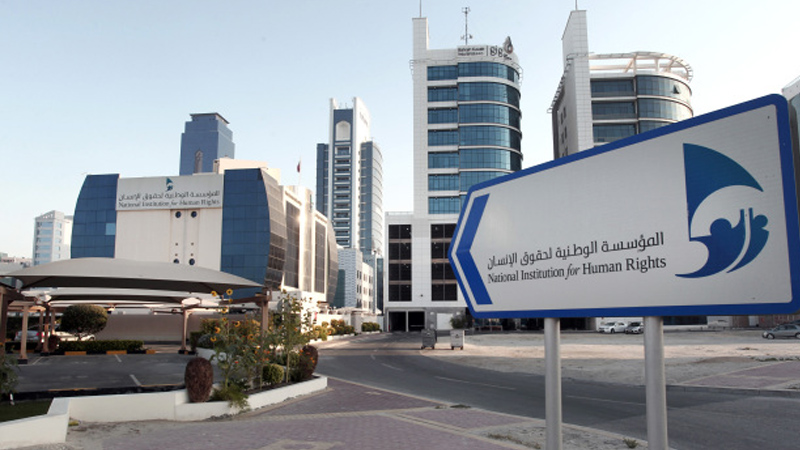
Bahrain's achievements have been highlighted by its rights watchdog, which will put forth 38 recommendations at a key UN session in November.
The National Institution for Human Rights (NIHR) will submit its parallel report to the United Nations Human Rights Council as part of Bahrain Universal Periodic Review’s fourth cycle.
The report will be reviewed during the 41st session of the council, which will be held from November 7 to 18.
The NIHR highlighted the Alternative Penalties and Measures Law, praising it as a ‘qualitative leap’ in Bahrain’s judicial policy as it deters convicts while integrating them in society and rehabilitating them psychologically, morally and socially.
It, however, stressed the need to make urgent amendments to the Citizenship Law to ensure Bahraini women married to foreigners can pass on the nationality to their children.
Among the recommendations are a new law to protect the rights of people with disabilities, including specifications and recommendations for their infrastructural needs in public utilities, tourist facilities, various modes of transportation and housing services.
The watchdog highlighted the importance of making the necessary amendments to the labour law to ensure women in the private sector enjoy similar benefits as those in the public sector, including two hours a day for child care.
It also expressed hope that the government would enact a special law to further protect rights of domestic workers, recruitment agencies and relevant parties.
The NIHR report – a copy of which was secured by our sister paper Akhbar Al Khaleej –stressed the importance of issuing a law on Non-Governmental Organisations (NGOs), which takes into account human rights developments, underpinned by guarantees that ensure the right to organise in line with the relevant UN resolutions.
With regard to the death penalty, the institution said it was in agreement with international standards and decisions that support everyone’s right to life.
Despite the fact that the death penalty may be applied in some serious crimes, under strict legal and judicial rules, and in very rare cases, the institution is working hard to ensure implementation of the UN resolutions on a moratorium on the use of the death penalty, it said.
The NIHR stressed the importance of enabling people facing the death penalty to exercise their right to request a pardon or commutation of their sentence by ensuring fairness and transparency in clemency process.
Bahrain’s human rights record was previously scrutinised in 2008, 2012 and 2017 as part of the Universal Periodic Review, which is a regular examination of human rights in the UN’s 193 member states.
The GDN earlier reported that Bahrain has started implementing the National Human Rights Plan (2022-2026) which covers four focal points – Civil and political rights; economic, social and cultural rights; rights of groups with priority care needs; and solidarity rights.
The new plan builds on existing rights achievements and incorporates 17 main objectives, 34 sub-objectives and 102 projects – each designed to achieve the desired targets, particularly in the areas of legislation, institutional development, capacity building and raising awareness.