

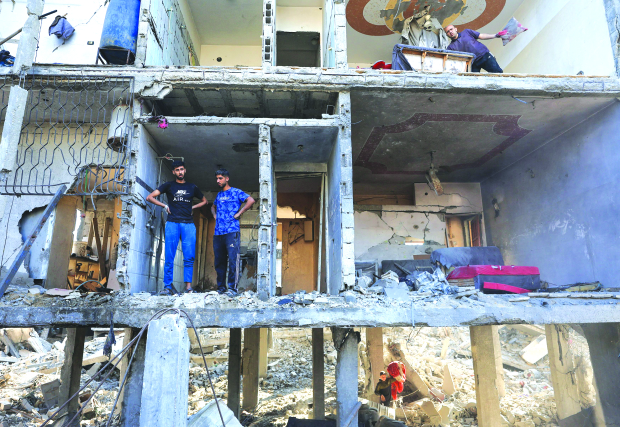
Hamas said yesterday that Israeli Prime Minister Benjamin Netanyahu’s declaration that his country would expand its area of control in Gaza was a dangerous escalation, as European states and residents of the Palestinian territory also voiced alarm at the plan.
Under a ceasefire deal in October Israel’s military was to remain in control of 53 per cent of Gaza, but Netanyahu said that it would expand that area to an initial 70pc, without laying out details or a timeline.
The Palestinian group described his comments as a plan for ethnic cleansing and forced displacement of Palestinians.
“Any attempt to impose a new reality of occupation in Gaza is null and illegitimate,” said Ismail Al Thawabta, head of the Hamas-run Gaza government media office, adding that Netanyahu’s statement ‘represents a dangerous escalation’.
More than eight months into the ceasefire, and with global attention fixed on the war in Iran, Gaza’s underlying conflict remains stubbornly unresolved with continued Israeli attacks, little aid reaching civilians and the risk of major new violence.
Israel has already expanded its area of control in Gaza from the 53pc lying behind a ‘yellow line’ mapped into the ceasefire deal up to around 64pc, with an area it has designated as restricted in maps shared with aid groups.
Any further reduction in space available to the more than two million Gaza residents who are mostly crammed into tents in the tiny Palestinian territory risks worsening already dire conditions there.
“Where do we go? To the sea? There is no space,” said a resident of Khan Younis.
Last year’s deal brokered by US President Donald Trump established a Board of Peace to oversee a phased ceasefire, and was ratified by the United Nations Security Council.
However, many of the toughest areas of dispute including the disarmament of Hamas, a full Israeli withdrawal and the make-up of a Gaza government were postponed to later in the process.
The Board of Peace negotiators have been talking to both sides on the disarmament issue.
Israel and Hamas have repeatedly accused each other of violating the truce.
Israeli strikes in Gaza have killed more than 900 Palestinians since the start of the truce while Palestinian attacks have killed four Israeli soldiers.
Israel’s military and the prime minister’s office did not immediately respond to a Reuters request for additional information and comment on Netanyahu’s statement.
A spokesperson for the Board of Peace said it would not have a comment on Netanyahu’s statement.
A British foreign ministry spokesperson said any further expansion of Israeli control in Gaza would be unacceptable and risk exacerbating an already dire humanitarian situation.
France did not immediately respond to requests for comment.
A German foreign ministry spokesperson said Germany was concerned about Israeli plans to take more of Gaza.
The United Nations yesterday added Israel and Russia to a UN blacklist of countries suspected of committing sexual violence in conflict zones, a move that prompted Israel’s foreign ministry to say it would sever all ties with UN Secretary-General Antonio Guterres.
Guterres’ annual report to the UN Security Council on conflict-related sexual violence goes a step further than last year, when he put Israel and Russia “on notice” that they could be added to the list of parties “credibly suspected of committing or being responsible for patterns of rape or other forms of sexual violence.”
The latest report does that and contains harrowing descriptions of abuses at the hands of Israeli and Russian armed and security forces.
Israel’s arch enemy Hamas, whose October 7, 2023, attack on southern Israel triggered the war in Gaza, was already on the blacklist and in a post on X on Thursday, Israel’s UN Ambassador Danny Danon said ranking Israel with the fighter group marked a “new low”.
“This is a political decision! Disconnected from the facts and reality!” Danon said in another post by the Israeli mission to the UN which said he was informed about it during a phone call with Guterres.
&uuid=(email))