

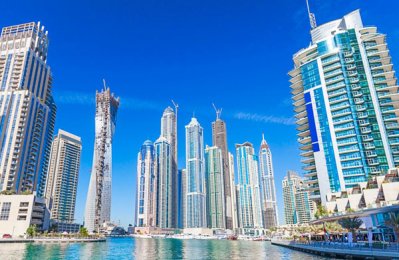
The UAE’s real estate sector continues to build momentum buoyed by a positive trajectory across its residential, office, retail and hospitality sectors during the third quarter of this year, said a leading real estate expert JLL.
Overall, average residential prices in Q3 grew by 9% year-on-year in Dubai, while average rental rates saw a 25% year-on-year increase, with both sales and rentals being bolstered by stronger demand and increased buyer activity, stated JLL in its latest UAE Real Estate Market Report.
Meanwhile, the sale prices in the capital grew by 4% year-on-year, while average rents rose by 2% year-on-year.
Abu Dhabi is seeing increased demand for new developments located within investment zones – especially for townhouses and villas, it added.
Across the UAE, price growth is being fueled by investor and end-user demand. Off-plan sales are high, while secondary market sales are also improving, in light of increasing yields, said JLL in its report.
The quarterly report suggests around 6,600 residential units were handed over in Dubai in Q3, raising total stock to 672,000 units, while an additional 20,000 units are scheduled for completion by year end.
In Abu Dhabi, approximately 1,900 units were delivered in Q3, bringing the Emirate’s total dwellings to roughly 278,000 units. The research suggests the capital plans another 2,000 units – mostly within master-planned communities – to be completed by year end.
Khawar Khan, the Head of Research at Middle East, Africa and Turkey at JLL, said: "End-users using mortgage finance to purchase properties have been rushing to lock-in fixed rates in an environment where both interest rates and rents are rising quickly. Indeed, Reidin’s citywide residential rent index showed annual growth of 25% in August."
"Price growth is also being fueled by investor demand. This category has been returning to the off-plan market in force, while sales in the secondary market have also picked up in view of the upward trajectory of yields," noted Khan.
On the office sector, JLL said Dubai’s Central Business District (CBD) rents saw a 24% year-on-year increase in Q3, caused by continued scarcity of good quality stock and no new office completions across the city.
The emirate anticipates the addition of 53,000 sq m of office space ready for handover by year-end. The city’s most central office space is currently close to capacity, with office vacancy rates standing at just 13%, approximately 8%-points lower than a year ago.
This quarter saw Dubai’s Grade A CBD rents reach an average of AED2,084 per sq m per annum, while Abu Dhabi saw a 9% year-on-year rise to AED 1,750 per sq m per annum.
While Abu Dhabi added 63,000 sq m of new office space to its stock since Q2, the bulk of enquiries in Q3 were regarding co-working and serviced offices, underlining that new post-pandemic hybrid working models are here to stay. There is no new office stock planned for Abu Dhabi’s Q4 pipeline, it stated.
The vacancy rate for Grade A and B office space in the capital fell by 3% over the last quarter, it added.
On the retail scenario, JLL said while the third quarter saw no new retail projects completed in either Dubai or Abu Dhabi, the sector’s Q4 activity looked set to welcome around 154,000 sq m of new retail space in Dubai and 197,000 sq m in the capital.
With ample supply available for retailers to choose from, potential tenants are being more strategic in selecting their locations for new outlets.
A moderate increase in retail rents (3% in Dubai and 5% in Abu Dhabi) reflects a sector benefitting from improving levels of consumer confidence, stated the industry expert.
While the easing in restrictions is helping footfall to recover, mall owners are recognizing the importance of differentiating their offerings in a landscape where there is ample supply. In view of greater competition, malls are introducing more experiential retail concepts and are seeking to have a greater variety of outlets for visitors to their properties, it added.
JLL anticipates more developers and landlords looking to bring in homegrown concepts – particularly in the F&B segment – as they have the appeal of offering experiences tailored to local needs, while also being relatively adaptable.-TradeArabia News Service
&uuid=(email))