

FOOTBALL – THE last time the football World Cup was held in the US was the year that the sitcom Friends was launched and the Channel tunnel linking England and France was officially opened.
At that time, US soccer, as it is known ‘stateside’, was considered a niche sport with no professional league. However, they still managed to deliver what remains the highest-attended competition in history. Despite the notoriously high ticket prices, expect Fifa 2026 to set new records.
Not that you might believe it from the Press coverage, but the US is co-hosting with Canada (who host for the first time) and Mexico. 1994 was also the year that apartheid was abolished in South Africa, making it somewhat ironic that they help launch the tournament in an opener at altitude in the iconic Mexican Estadio Azteca, home of the finals in 1970 and 1986.
So which of the 48 teams will you be supporting throughout the 104 matches crammed into 39 days across four time zones and 16 venues up to 2,800 miles apart? If your home country is not playing, then perhaps you have a favourite league team with players representing their country? For example, Hull City, newly promoted to the Premier League, have Hadziahmetovic representing Bosnia and Herzegovina, while their forward, Liam Millar, plays for the co-hosts, Canada. Tigers fans are therefore guaranteed some interest into the knockout stages as both teams are in Group B with three teams out of four progressing.
If you have a regional interest, eight teams have qualified. Saudi Arabia, hosts in 2034, have qualified for the World Cup for the seventh time and will be hoping for a repeat of their performance at Qatar 2022, when they produced the shock of the competition, defeating eventual winners Argentina in the group stage. The Green Falcons open their campaign against another South American team, Uruguay, on June 16.
I will personally be cheering on Jordan, having qualified for the first time, hoping that influential attacking midfielder, Hassan Abdel-Fattah, can reproduce his clinical finishing and spectacular goals. The courageous Neshama welcome back captain Ehsan Haddad and have an opportunity to replicate the Saudi result, facing Argentina in their final group game.
Other tournament debutants in this expanded competition include the tiny Caribbean island of Curacao, who will become the smallest nation to participate when they open their campaign against four-time winners, Germany.
The ‘Blue Wave’ is 37 miles off Venezuela and has a population marginally exceeding 150,000 and is smaller than Bahrain; however, being an autonomous country within the Kingdom of the Netherlands, they have benefited from some Dutch-raised talent and easier qualifying with the US admitted automatically as hosts. They will be coached by the oldest manager in World Cup history, Dick Advocaat, aged 78.
They are joined by an archipelago of 10 islands, Cape Verde, and Asia’s other debutante, Uzbekistan. Yet none of these feature within the lowest-ranked nations participating. If you fancy a major upset, then look towards Haiti (ranked 83) or New Zealand (85). Qatar, ranked 55th, are in the statistically weakest group in competition history.
Perhaps you might prefer to join a street party when choosing who to support, in which case Sweden and Holland are typically well-represented and easily identified! Sweden struggled early in qualifying with only one point from their first four matches but some magic from new manager, Potter (Graham not Harry), saw them secure a last-minute play-off victory against Poland to ensure they reached North America.
They will be missing captain Dejan Kulusevski while star striker Alexander Isak has only recently returned from injury. However, they do possess Swedish Royalty; Baron Gustaf Lagerbielke, the Braga defender, is 254th in line for the throne. The Blagult (blue and yellow) fans will be hard to miss and likely singing their Kanna Pa rendition referencing a Viking invasion of 100,000!
The Oranje have already shipped their famous orange double-decker bus that will drive through the streets of Dallas and Houston. DJs playing from the open top tier will be followed by thousands clamouring for ‘Links-Rechts’ by Snollebollekes. On the pitch they will be hampered by injuries to several key personnel including Simons and Matthijs de Ligt. Others have recently returned, although they still possess genuine quality with the likes of Virgil van Dijk, Micky van der Ven and Tijjani Reijnders.
Host nations typically exceed expectations although don’t expect any of the three to become one of the six to historically have lifted the Jules Rimet trophy on home soil. Statistically, 70 per cent of hosts have produced their best ever finishes. For example, El Tri (Mexico) have only reached the quarter-finals twice, both when they hosted previously. Don’t expect them to add to the 13 previous host nations to have made it as far as the semi-final.
As a co-host, Mexico didn’t have to navigate the gruelling Concacaf qualifying campaign, which allowed manager Javier Aguirre to experiment; it cost them competitive match rhythm, although they have secured several wins against weaker opposition. Under Aguirre they operate a pragmatic, defence-first identity rather than a heavily aesthetic one. Utilising a flexible four-three-three formation, El Tri relies on an aggressive press, solid midfield anchoring by Edson Álvarez, and a sturdy defensive line.
The US men’s national team (USMNT) has undergone considerable change under Mauricio Pochettino limiting opportunities to forge partnerships. However, for the first time since taking charge 25 games ago, he was able to field two wing-backs, Robinson and Dest. With Adams and Freeman in midfield, Pulisic looked much more effective up front, resulting in a confidence-boosting 3-2 win over Senegal.
Under manager Jesse Marsch, the Canadian men’s national team has evolved into an aggressive, pressing side built to punish opponents quickly upon recovering the ball. The squad features a lethal core of European-based talent, headlined by Bayern Munich’s Alphonso Davies, Lille’s Jonathan David, and Mallorca’s Cyle Larin, although they pose more of a threat from set pieces.
This competition is likely to produce some surprises. Eight of the stadia will be importing temporary grass pitches, while two, Mexico City and Guadalajara, are at altitude. Miami and Monterrey practically guarantee matches to be played in energy-sapping heat and humidity, which will impact teams in subsequent games unless they are able to rotate their squads. This, despite the World Cup returning to its traditional summer slot after its winter holiday in Qatar. USA 1994 produced one of the historic upsets with Bulgaria (ranked 29) defeating the top-ranked Germany, playing for the first time as a unified nation following the dissolution of the USSR.
Genuine contenders
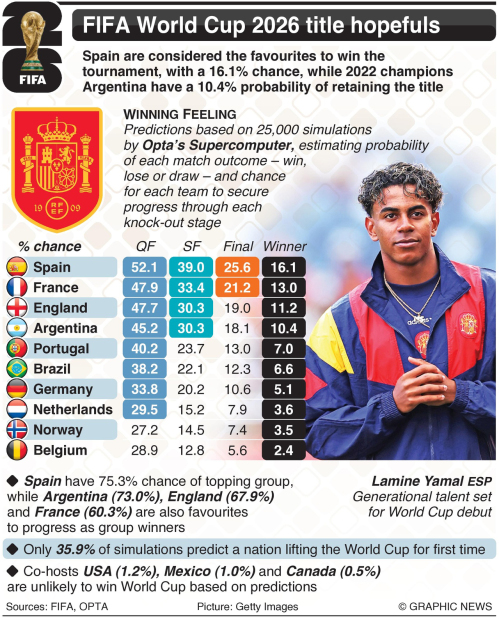
If you are looking for genuine contenders in this year’s World Cup, then look no further than the top-ranked teams.
Italy (13) was the last team ranked outside the top 10 to win the trophy, which occurred in 2006. They failed to qualify this year.
The top two-ranked countries, almost on equal status, are Spain and France.
Lamine Yamal is Spain’s wonderkid. Aged 18, he has won a European Championship and now occupies Messi’s number 10 Barcelona shirt. His serenity transcends the game and makes his dribbling look effortless. Spain coach Luis de la Fuente believes he has been blessed by God. Unfortunately for La Roja, there are concerns about his fitness, along with Williams who operates on the opposite flank. They also possess 2024 Ballon d’Or winner Rodri, alongside Zubimendi and Pedri. From a performance perspective, they have had an almost flawless route to the finals.
Under the guidance of experienced leader, Luis de la Fuente, they have evolved from the tiki-taka era and adapt styles to the match-day situation. They can retain possession but also have blistering pace in transition. Defensively, they have two of the best goalkeepers in world football with Arsenal’s golden-glove winner, Raya, kept on the bench by Bilbao’s Simon. The big talking point is the lack of any Real Madrid players in the squad!
France, under veteran coach Didier Deschamps, boast one of the most feared attacking line-ups in history. Who can contain the pace and creativity Mbappe, Olise, Cherki, Ekitike with Barcola and Doue riding high on Champions League success? If they need a target man, they have Mateta and Thuram.
Defensively, they are led by Saliba and Upemachano, overlapping fullbacks with Gusto, Kounde and Hernandez, and midfield anchors in Tchouameni and Rabiot. Tactically, they are geared towards getting the ball quickly to their dynamic forwards who rotate to confuse opposition defensive structures. They heavily utilise their forward-looking fullbacks. It will be intriguing to see how they adapt in the heat and whether they learned lessons from PSG’s defeat in the Club World Cup last summer.
Argentina are the defending champions and qualified from the South American group by a massive margin. The Albiceleste are perhaps the one team more dominant recently than Spain. Much will depend on how youthful the evergreen Lionel Messi feels although his strike partner, Julian Alvarez, is one of the most sought-after transfers in the European leagues. Emi Martinez is their ‘larger than life’ goalkeeper, who has historically proven to be a valuable asset in high-pressure situations.
Lionel Scaloni has selected a veteran-heavy squad marshalled at the back by the Premier League pair of Romero and Martinez. Further forward, they allow Messi to roam free, frequently dropping deep to create space to exploit. If they lose the ball they will try to press the opposition high up the pitch into returning it. They are the favourites from a strong Latin American contingent to claim the spoils.
In a tournament that is likely to test the depth of talent available, perhaps one way to assess quality is to consider who missed out. In France, there was great debate about the omission of Todibo, Disasi and Muani, while Spain’s debate was more aimed at the aforementioned club ‘politics’. In England, the arguments have raged because of the perceived inability of those included!
Jordan Henderson, who made only 22 starts for Brentford this season, will turn 36 during the tournament and is keeping the likes of Palmer, Foden and Gibbs-White at home. There’s an argument that he brings a different style of play, in which case why not plump for Wharton, whose performances for Crystal Palace have linked him to a sizeable transfer to much bigger clubs. I’m not personally a huge fan of Harry Maguire, although there’s no doubting his importance to the Manchester United back line.
Thomas Tuchel did ensure that England has Real Madrid presence (even without Alexander-Arnold) by ending the debate about Jude Bellingham to support talisman Harry Kane. There is some incredible individual talent; is there a more disruptive and athletic midfield fulcrum than Rice and Anderson, feeding Rashford, Saka and Barcelona’s new signing, Gordon? O’Reilly and Guehi have had great finishes to the season with Manchester City. However, the issues with this generation of talent appear to be whether they can play as a team. A longer tournament may help, although there is an argument that English-based players will suffer more than most due to the length and arduous nature of their season.
Julian Nagelsman spearheads German football and remains faithful to their aggressive heritage of Gegenpressing, overloading the midfield areas to restrict space. He often deploys interchangeable playmakers supported by aggressive wingbacks, although that can occasionally leave them exposed defensively.
Musiala and Wirtz provide creativity linking with Havertz and Beier, while Nmecha provides cover. Rudiger and Tah are an imposing backline, which benefits from the return of Manuel Neuer, who reversed his earlier decision to retire. In their qualifying group and recent friendlies, they have bullied weaker opposition although struggled in competitive matches against Portugal and France, losing to both in the Nations League playoffs.
My outside tip, if you can apply that label to five-time winners, is Brazil. Successful in USA 1994, they have recently been searching for an identity and consistency. While defeating Panama 6-2 is hardly headline news, with six different scorers, it does suggest that Carlo Ancelotti can harness the considerable talent – and egos – of players like Vinicius Jr, Raphinha and Neymar. However, they last lifted the trophy in 2002, so will be hoping Ancelotti can add the World Cup to a record five Champions League titles!
It’s ironic that there are off-field controversies about ICE in a competition that will be one of the hottest on record. The excessive heat that played such a part in the Club World Cup last year, along with the extended format of the competition, will test squads to the limit.
I’m therefore plumping for teams with possession-based styles in Spain and Brazil. Spain and France probably boast better squads, but I’m going for Brazil – surely it’s about time?
sport@gdnmedia.bh
&uuid=(email))