Evolution of the space sector could lead to the emergence of more private enterprises in Bahrain and the GCC that seek to capitalise and build products on top of collected data.
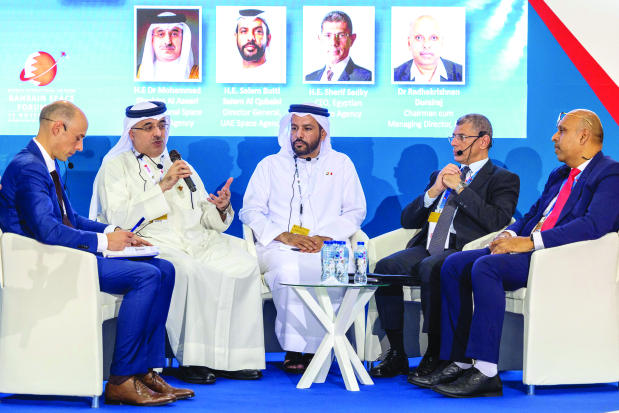
National Space Science Agency (NSSA) chief executive Dr Mohamed Ebrahim Al Aseeri, along with other panelists, revealed this in a forum focused on how to engage new generations in space.
The event was held as part of the Bahrain International Airshow (BIAS) yesterday.
“The space sector is evolving towards having more private enterprises involved in the sector,” Dr Al Aseeri said, during his comments at the forum.
“Overall, young Bahrainis are currently more interested in working with public space sector stakeholders. But I believe, with time, they will start shifting towards the private sector, once they believe the environment is conducive, and there is an ecosystem to support them.”
Dr Al Aseeri’s opinion was formed as a result of a survey to determine how best to engage with future generations of space scientists, and based on their results, the agency is currently focusing on capacity-building by integrating more space-related material into the educational curriculum.
The survey also found that the paradigm amongst Bahraini students was shifting and that more youngsters were starting to look at space as a viable career option.
The UAE and Egypt are increasingly being seen as role models, in terms of healthy space ecosystems.
The UAE’s Space Agency (UAESA) has made this a core part of its 2030 Space Strategy and is engaging “an ecosystem of companies and SMEs (small and medium-sized enterprises) in its upcoming projects”, according to the agency’s director-general Salem Al Qubaisi.
The UAESA is currently working on sending a satellite to orbit Mars, and is also hoping to build a Mars Science City within Dubai, by 2024.
“The future of space is entrepreneurs, and the current goal should be to set up the right infrastructure for them to succeed,” added Egyptian Space Agency chief executive Dr Sherif Sedky.
Dr Sedky also added that international collaboration plays a huge role in space, and having agreements for knowledge-sharing and technology transfer regionally would equip entrepreneurs for the next cycle of the regional space programme.
Dr Sedky, Mr Al Qubaisi and Dr Al Aseeri also confirmed that the Arab Space Co-operation Group had met three days ago to discuss lessons learned from recent space ventures and how to build capacity for the growth of the sector.