

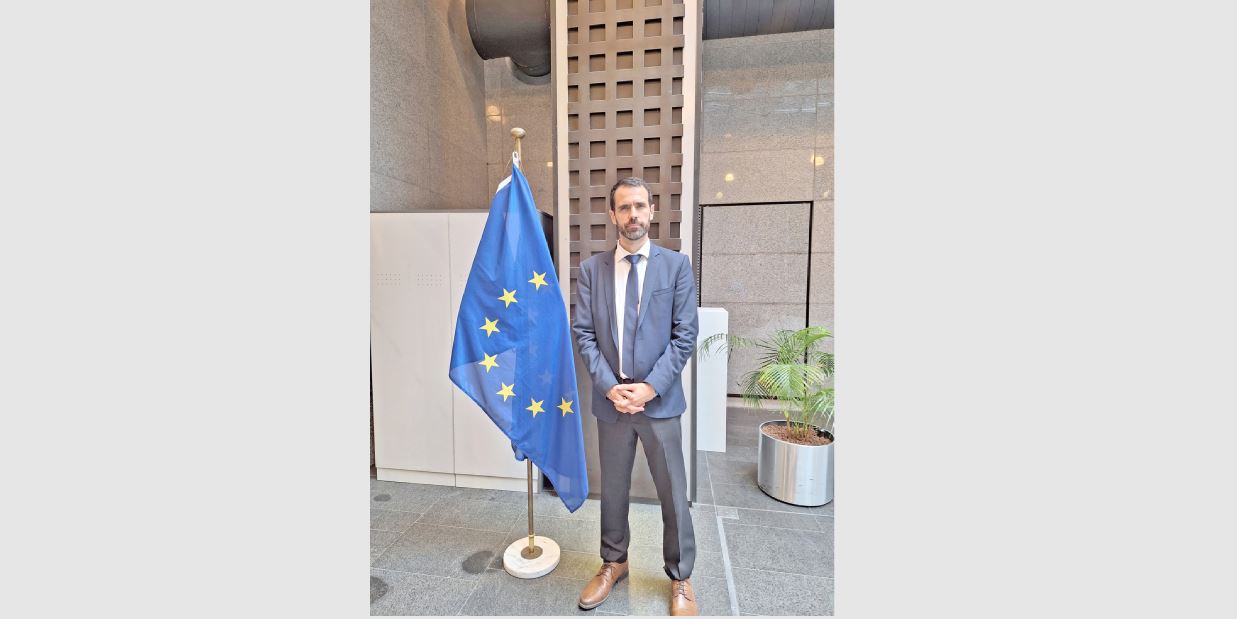
The European Union (EU) is aiming for an ongoing dialogue with Bahrain and the rest of the GCC around many issues including human rights, without ‘imposing its values’, according to a top official from the EU’s executive branch.
By Naman Arora in Brussels, Belgium
The EU’s regional media officer and Arabic spokesperson for MENA Luis Miguel Bueno Padilla also clarified that the European Union’s position currently on human rights in Bahrain is one of ‘co-operation and dialogue’, differentiating it from the controversial resolution that the European Parliament passed last year around alleged human rights violation by the kingdom, which was rejected by the Foreign Ministry, Parliament and the Shura Council.
“Our position right now is on the supposition of co-operation, and we insist on the importance of holding this dialogue to discuss particular issues related to youth, women and others that are of relevance to the Bahraini authorities,” Mr Padilla told the GDN on the sidelines of an ongoing EU familiarisation visit for journalists from the GCC, taking place in Brussels.
In December last year, the European Parliament passed a resolution alleging human rights abuses in Bahrain, citing as evidence the case of Bahraini citizen who was duly convicted by the courts for treason and undermining state security, attempting to overthrow the constitutional government, communicating with foreign countries to carry out hostile acts against the kingdom, its citizens and residents, and establishing and managing an unlawful organisation to carry out acts of terrorism and sabotage.
The resolution was roundly rejected by countries across the Arab world, including the Arab League which highlighted Bahrain’s support for the establishment of the Arab Court for Human Rights and its ratification of the Arab Charter for Human Rights.
In a statement, the ministry noted that the court verdict corresponded to the legal consequences that would follow in any country respectful of the rule of law, as reported in the GDN. It said that it was disappointed and concerned with the inaccurate allegations contained within the resolution, which bore no resemblance to reality.
“Resolutions from the European Parliament on human rights are non-binding recommendations issued by the parliament,” Mr Padilla clarified. “The resolution is not the official position of the EU as a whole – it is an expression of the European Parliament towards an issue.”
The Beirut-based European diplomat, who became the EU’s first-ever Arabic-speaking regional media contact, insisted that the EU seeks to have dialogues with every Gulf country on human rights, however this doesn’t mean that the EU wants to impose its values, but rather ‘share expertise’.
“The idea here is to try to find opportunities to see where the EU can offer our expertise, without imposing anything, because the European countries have been through a lot and many of these issues were not satisfactorily tackled in our own countries,” he added, citing the example of his home country of Spain, which restricted women’s rights well into the second half of the 20th century.
In October last year, Bahrain and the EU held their 6th Human Rights Dialogue in Manama covering freedom of expression and association, rule of law, women’s rights and gender equality, labour rights and freedom of religion or belief.
When asked about the EU’s mandate for human rights in the GCC, Mr Padilla noted that it is ‘the same as all over the world where human rights are discussed with every single one of its partners’.
“We have informal and formal human rights dialogues in agreement with the local authorities and these are a good platform to discuss issues away from other dialogues that we have on political and economic issues,” he added.
naman@gdnmedia.bh
&uuid=(email))