

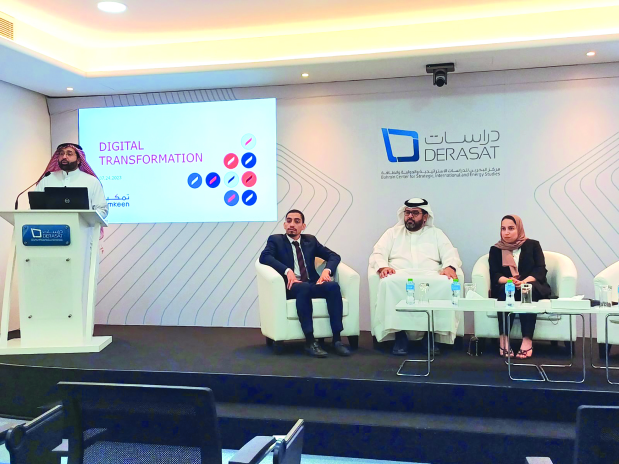
Business executives have been urged to do their homework before jumping on the high tech bandwagon and spending vast sums on digital transformation projects.
This message was highlighted yesterday during a talk entitled ‘Common Challenges and Coping Measures in the Process of Digital Transformation’ hosted by the Bahrain Centre for Strategic, International and Energy Studies (Derasat) at its Awali headquarters.
During the discussion, experts from Labour Fund (Tamkeen) highlighted the importance of companies researching the best solutions before rushing into a systematic overhaul on a trendy whim.
“Digital transformation can be a great thing,” said Tamkeen business and sector intelligence director Mazen Alsaleh. “If we wanted to watch a movie in the past, we had to go to the cinema, look at what was on, check the timings, and see if any tickets were available.
“Now, we can often do all that from the comfort of our own homes.”
Digital transformation is the integration of digital technology into a business, fundamentally changing how a company operates. The aim is to be customer centric, data driven and platform-oriented, carried out with the aim of streamlining work and increasing customer and workplace satisfaction.
It has become a major component of business development worldwide, with estimated global spending more than doubling from $1 trillion in 2018 to $2.16trn in 2023.
Mr Alsaleh, however, stated that the decision to undergo the process should be done only after extensive research. “It does not work well when decisions are made based on intuition instead of data,” he said.
“You cannot just jump into it, you need to create a roadmap and actually understand the platform you are implementing for your employees and customers.”
Tamkeen executive director Abdulla Aljowder described the roadmap to digital transformation as ‘absolutely crucial’ for its success.
“Assess your business and think about why you want to implement a new system,” he said. “Then, evaluate your staff’s current capabilities and identify a course of action.
“The most important thing, however, is to ensure that executives and directors are fully on board with the idea. If you fail to garner their support, the project is dead before it even starts.”
Other potential challenges that Mr Aljowder identified are the potential lack of IT expertise in-house, what to do with the old system already in place and any cost constraints.
“Do not begin any projects without identifying each and every potential problem that may arise,” he advised.
Tamkeen’s transformation lead Fatima Abbas said companies should conduct workshops and brainstorming sessions with all employees before introducing new initiatives.
“There will be people resisting change – that is human nature – but let them know why you are doing this,” she explained. “Some employees will be concerned that they could lose their jobs. Let them know it is not about replacing them but rather to make their jobs easier.
“Finally, make sure everyone involved understands that the new system needs to be built piece by piece and that it will take time to fully implement.
“If it is not done correctly, employees won’t use it and neither will customers.”
She warned attendees of the potentially ‘nightmare’ scenario of wasting time, effort and money on a new system that rather than improve the workplace and customer experience, makes it worse.
Examples of getting it right were shown too. The most notable digital transformation in Bahrain in recent years was the successful implementation of the BeAware App during the Covid-19 pandemic back in 2020.
Bahrain had impressive success during the pandemic, in part, thanks to the application which streamlined vaccination information and highlighted health status.
A report released by the United Nations last year placed Bahrain in the very high E-Government Development Index (EGDI) category.
And, the kingdom is not sitting on its laurels. “Bahrain has a lot of potential but we need to market ourselves better to reach it fully,” added Mr Aljowder.
nader@gdnmedia.bh
&uuid=(email))