

BAHRAIN is going back to its roots – by planting almond saplings in parks, gardens and walkways across Muharraq.
The initiative is aimed at capitalising on the interest generated in the once widely cultivated edible seed by a popular ice cream – and the first-ever almond festival earlier this month.
The campaign was launched by the Municipalities and Agriculture Ministry under the theme, ‘United Forearms’.
It is being spearheaded by the Muharraq Municipality in co-ordination with the Muharraq Municipal Council and in partnership with the Muharraq Parks’ Friends and the Islamic Association.
The first batch of seedlings was planted in a ceremony at Arad Walkway, followed by Aladdin Public Park in old Muharraq.
The governorate has 50 parks, gardens and walkways.
“We will plant 20 almond saplings in each park, walkway and garden in the governorate,” said the council’s services and public utilities committee chairman Ahmed Al Meghawi, who is also Arad councillor.
“There is regional interest in almonds and all eyes are on Bahrain for the fruit, so why not use it to boost our almond industry,” he added.
“Almond is giving the country an unexpected favourable image and why not have voluntary work, and community and municipal activities and programmes, all revolve around this concept?
“That’s what we have done here under the first phase, which will be expanded to include 20 more trees per facility tentatively in September, depending on the need.”
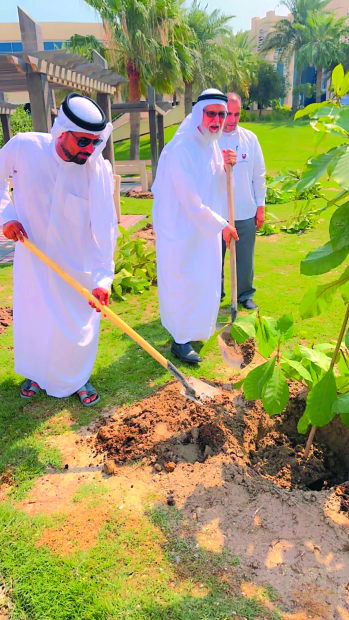
Mr Mohammed Al Meghawi, left, and Dr Shaikh Al Mahmood, second from left, planting almond seedlings
Mr Al Meghawi was accompanied at yesterday’s ceremony by the council’s financial, administrative and legislative committee chairman Fadhel Al Oud and his nephew and Hidd councillor Mohammed Al Meghawi.
Meanwhile, Islamic Association board chairman Dr Shaikh Abdullatif Al Shaikh said the initiative reminds him of Bahrain until the 1950s.
“This move aims to restore a bygone era when almond was the tree that filled neighbourhoods, alleys and roads,” he said.
The almond tree can grow up to 35 metres in height, with an upright, symmetrical crown and horizontal branches. It produces a green fruit, which ripens to yellow and red, containing a single seed.
Almonds are low in carbohydrates but high in protein, healthful fats, and fibre. The leaves and bark have been used in herbal medicines to treat a variety of ailments, from dysentery and diarrhoea to liver disease.
The GDN reported earlier this month how almond ice cream, being sold from a food truck in Sanad, had drawn people from other GCC nations.
Spurring this interest was the maiden Almond Festival held on July 8 at the Budaiya Botanical Gardens when around 500kg of almonds were snapped by anxious lovers within 30 minutes at BD6 a kilo.
The same happened in the following week as the stone fruit was snapped up in the same period despite the prices doubling to BD12 a kilo.
The market prices have now stabilised at BD10 a kilo, but huge demand could drive the prices further up.
“We will try to provide the fruit for free or at lower prices to people,” said Al Meghawi.
mohammed@gdnmedia.bh
&uuid=(email))