

Western-backed maritime forces in the Middle East yesterday warned shippers travelling through the strategic Strait of Hormuz to stay as far away from Iranian territorial waters as possible to avoid being seized, a stark advisory amid heightened tensions between Iran and the US.
A similar warning went out to shippers earlier this year ahead of Iran seizing two tankers travelling near the strait, the narrow mouth of the Gulf through which 20 per cent of the world’s oil passes.
Bahrain-based Fifth Fleet spokesman Commander Tim Hawkins acknowledged the warning had been given, but declined to discuss specifics about it.
A US-backed maritime group called the International Maritime Security Construct “is notifying regional mariners of appropriate precautions to minimise the risk of seizure based on current regional tensions, which we seek to de-escalate,” Hawkins said.
“Vessels are being advised to transit as far away from Iranian territorial waters as possible.”
Separately, a European Union-led maritime organisation watching shipping in the strait “have warned of a possibility of an attack on a merchant vessel of unknown flag in the Strait of Hormuz in the next 12 to 72 hours,” said private intelligence firm Ambrey.
“Previously, after a similar warning was issued, a merchant vessel was seized by Iranian authorities under a false pretext,” the firm warned.
The EU-led mission, called the European Maritime Awareness in the Strait of Hormuz, did not immediately respond to a request for comment.
Iran through its state media did not acknowledge any new plans to interdict vessels in the strait. Iran’s mission to the United Nations did not immediately respond to a request for comment.
More than 3,000 US sailors and marines have arrived in Bahrain in a show of force amid tensions with Iran – with a mission to protect commercial ships transiting through the Strait of Hormuz, as reported by the GDN.
The personnel joined the Fifth Fleet area of operation following an announcement of their deployment by the US Department of Defence as part of a military build-up.
The Pentagon last month sent additional F-35 and F-16 fighter jets along with a warship to the Middle East in a bid to monitor key waterways in the region following Iran’s seizure and harassment of commercial shipping vessels.
US forces last month prevented two attempted commercial tanker seizures by the Iranian Navy, which had opened fire in one of the incidents near the coast of Oman in international waters.
In the first incident, one Iranian naval vessel approached the Marshall Islands-flagged oil tanker TRF Moss in international waters in the Gulf of Oman.
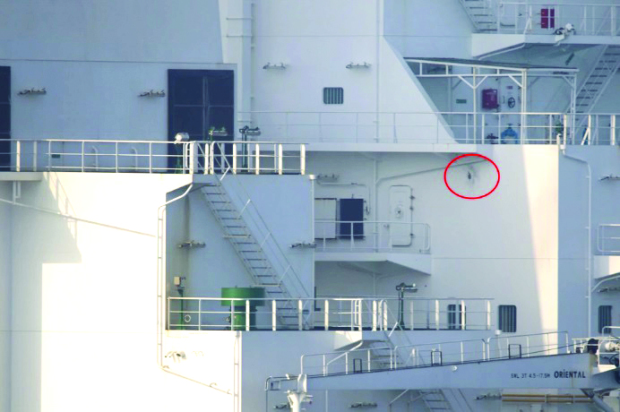
Another Iranian vessel came within one mile of Bahamian-flagged oil tanker Richmond Voyager while the ship was more than 20 miles off the coast of Muscat, Oman, and transiting international waters toward the Arabian Sea.
Iranian personnel fired multiple, long bursts from both small arms and crew-served weapons at Richmond Voyager.
There were no casualties but several rounds hit the ship’s hull near crew living spaces.
Iranian news agencies have also reported that it has equipped its Revolutionary Guards’ navy with drones and 1,000-km range missiles to boost its capability.
&uuid=(email))