

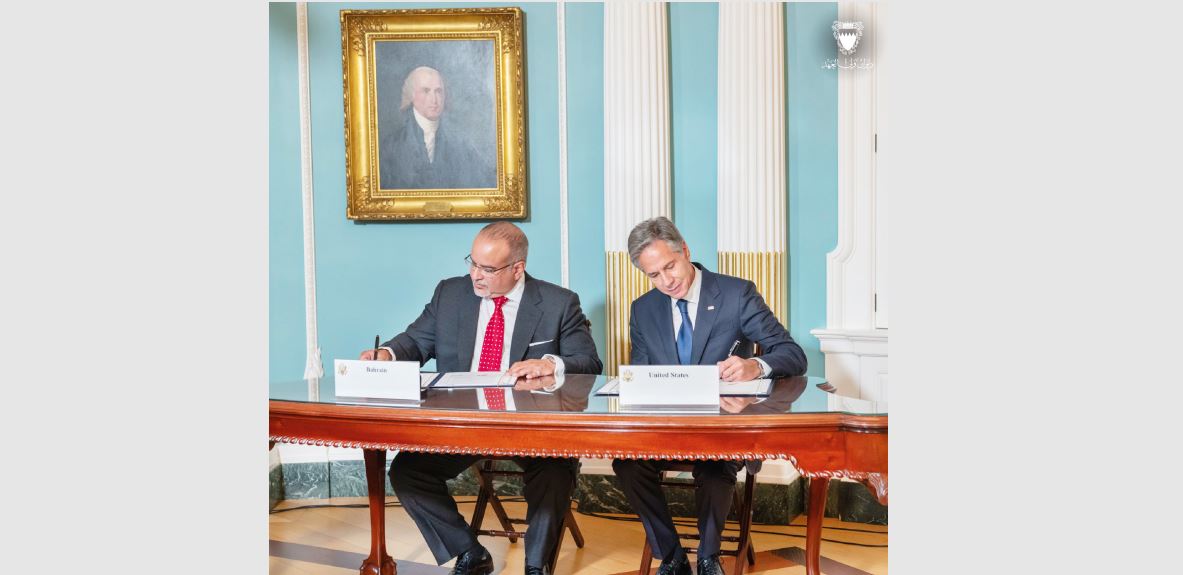
AN historic security agreement signed between Bahrain and the US will ‘punish any future aggressor’ and slam the narrative of America withdrawing from the Middle East, a top official has said.
Bahrain Ambassador to the US Shaikh Abdulla bin Rashid Al Khalifa asserted that the landmark accord signed last week between leaders of the two countries would ensure long-term regional stability and security.
His Royal Highness Prince Salman bin Hamad Al Khalifa, Crown Prince and Prime Minister, signed the Comprehensive Security Integration and Prosperity Agreement (C-SIPA) last week in Washington with US Secretary of State Antony Blinken, as reported in the GDN.
The C-SIPA formalises co-operation “to deter conflict in the region, enhance regional stability, de-escalate tensions, and bolster trade and economic co-operation – including through the development and deployment of advanced technologies with trusted vendors.”
In addition, plans were announced to start direct flights between Bahrain and the US by next summer.
Shaikh Abdulla, who accompanied the Bahrain delegation led by HRH Prince Salman, said from the kingdom’s perspective, ‘America was never going anywhere’.
“The US Navy’s choice to make Manama the Fifth Fleet’s home assured air and land forces would be stationed up and down the western littoral of the Arabian Gulf, working hand-in-glove with friendly Arab states, fulfilling their mission to protect the world’s most important sea lanes,” said the diplomat in an op-ed published in The Washington Times.
Shaikh Abdulla pointed out that before his arrival in Washington in 2017, several critics had bemoaned America’s withdrawal from the region, and its shifting focus to Asia.
However, he said a stable future in the Middle East requires US capability and reliability to manage shared global challenges. These include “obvious security threats as well as less conventional dangers, such as malign non-state actors, climate change, pandemics, economic instability, and rapidly accelerating advances in technology”, he added.
According to the diplomat, Bahrain has long believed that a stronger, tighter, closer bilateral relationship was in the best interest of the two nations.
The Middle East has experienced numerous inflection points such as the Six Day (1967 Arab- Israeli) and Yom Kippur Wars (1973 Arab- Israeli), the Iranian Revolution, the surging of US troops into Saudi Arabia, Iraq’s invasion of Kuwait, 9/11 attacks, and the Abraham Accords, he wrote, in the op-ed.
“I believe the C-SIPA will prove similarly transformative, setting a new standard for regional co-operation across a broad spectrum of sectors,” he added.
The Crown Prince and Prime Minister’s visit to Washington last week is the culmination of nearly a year’s worth of diplomatic engagement, including multiple trips to Manama by senior US officials.
It also follows HRH Prince Salman’s visit to Washington last year and his meeting with Vice President Kamala Harris.
The agreement mentions that ‘in the event of external aggression or the threat of external aggression,” the parties commit themselves “to develop and implement appropriate defence and deterrent responses.’
“This article establishes a new, more sensitive trip wire that should dissuade and will certainly punish any future aggressor,” added Shaikh Abdulla.
“This agreement sends a clear and unmistakable message to friend and foe alike: the interests of the United States and the region are inextricably linked.
“The essential logic of C-SIPA is: We need each other, we will help each other, and we can count on each other.”
He added the agreement will have ripple effects in the region, and said it was not a mere defence pact.
“Bahrain may be the first country to partner in this way with the United States, but it won’t be the last,” he said.
“It (agreement) recognises that effective and lasting security depends not just on arms but also on economic growth and opportunity.
“For this reason, investment and scientific and technical co-operation are fundamental components of a comprehensive agreement.
“They are indispensable for our mutual stability and prosperity over the long term.”
&uuid=(email))