

A TENDER for the first phase of the Bahrain Metro project covering 29km and 20 stations across the country is set to be issued soon, revealed a senior Transportation and Telecommunications official yesterday.
Land transport projects chief Fadwah Zaid said a 35-year ‘concession contract’ covering design, construction, funding, operation and maintenance will be held by closed-tender amongst the seven consortiums that have pre-qualified to bid.
She explained that the successful bidder – from consortiums involving different countries including Bahrain, China, India, Egypt, Saudi Arabia, as well as some from Europe such as France and Italy – will have five years to construct and 30 years to operate the metro and will need to present a new blueprint for the project.
The GDN earlier reported that the project had already cost the government BD7.5 million up until 2022. A further BD11.7m has been allocated for this year and next in the 2023-2024 budget, and a further BD91.3m until completion in 2029.
“Bahrain Metro is a strategic project that would provide a reliable transport system expected to be operating by 2030,” said Ms Zaid. “It’s a shift away from the current heavy dependence on private vehicles.
“This is the first of its kind in the region to be carried out in partnership with the private sector and we have selected ‘the best of the best’ to design, construct, fund, operate and carry out maintenance,” she added.
“We’re ready to issue the tender at any moment and just await the go-ahead from other partners in the government.
“The first phase covering two paths will see the red line start from Bahrain International Airport to the Seef District and the blue line from Juffair to the Bahrain Metro Warehouse in Isa Town.
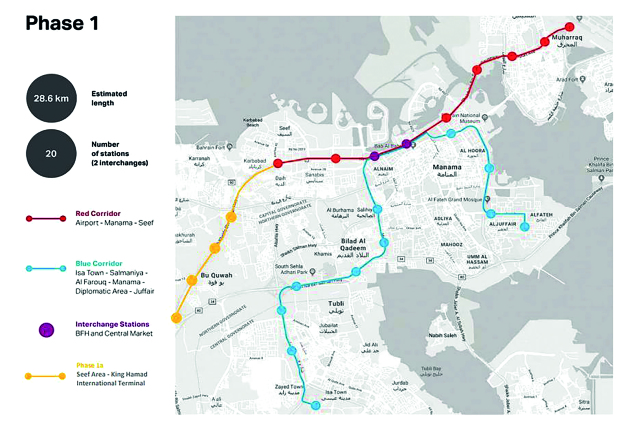
The phase one route
“There will be two switch stops near Farouk Junction and the Manama Central Market.”
She added that The King Hamad International Station, built over 1msqm opposite IKEA, would be linked to the metro system through a yellow line starting from Seef District.
“Financial, legal and technical advisers have worked with us to review all previous studies and issue all related details for the project, while eliminating any obstacles that may have affected progress or accessibility,” said Ms Zaid.
She added that no new infrastructure services or developments would be allowed around areas earmarked for the project.
“The stations and tracks will be suspended at a high elevation and, as a result, we have not had to purchase vast amounts of private property and there are no privacy issues. We may, however, need to secure some land for the entrances and exits of stations and stops.
Special provision has been made to ensure the view of the Al Fateh Islamic Centre is not interfered with and environmental studies on the impact of the work are ongoing.
“Ground cables and pipelines have to be removed so whenever the winning bidder is selected, they can start work from day one,” she said.
In response to a question on the future cost of using the metro, Ms Zaid promised the fares would be ‘affordable’ to encourage people to use it.
Bahrain first announced plans in 2018 to develop a 109km fully-automated, driverless metro system in four phases, estimated at the time, to cost around $2 billion.
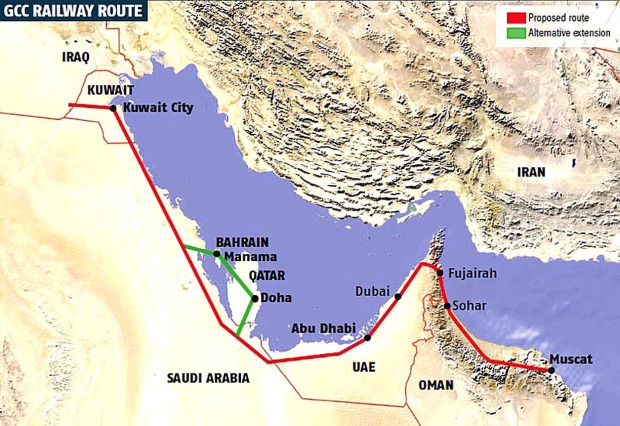
The GCC railway route
Ms Zaid, who was speaking at an open majlis of the Capital Trustees Board in Bilad Al Qadeem, added that a third 8km four-station path to The King Hamad International Station in Al Ramli District had been proposed but a decision awaited confirmation regarding the proposed GCC-wide railway project.
mohammed@gdnmedia.bh
&uuid=(email))